India's parliament has passed a controversial bill that seeks to change how transgender people are legally recognised and their right to self-identify, amid protests by opposition parties and the LGBTQ community. The government argues that the changes will simplify access to welfare benefits and strengthen protections against exploitation and trafficking. However, critics warn that it could exclude many transgender, non-binary, and gender-fluid individuals.
According to estimates, India is home to around two million transgender individuals, but activists believe the actual numbers are higher, citing inconsistent legal recognition and ongoing discrimination.
The bill, which awaits the president's approval, aims to refine the existing law established by the Transgender Persons (Protection of Rights) Act enacted in 2019, primarily focusing on the definition of a transgender person. The government maintains that the current definitions are inadequate, claiming a more precise definition will enable aid to reach vulnerable groups more effectively.
Nonetheless, concerns have surfaced that the new bill limits recognition to those defined by biological traits, stripping away the right to self-identify, a principle acknowledged by the Supreme Court in 2014. This has raised fears about the potential for increased discrimination.
Critics of the bill, including many activists, state that the required certifications for gender-affirming surgeries compromise the dignity and autonomy of transgender individuals and will foster exclusion among those who rely on self-identification.
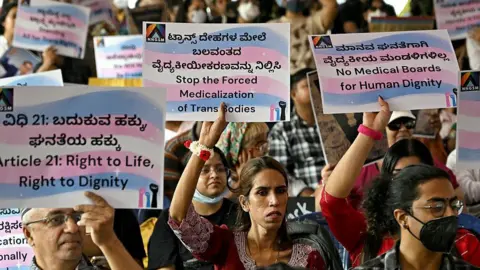
Activists have condemned the changes, describing them as an infringement on fundamental rights and dignity. They argue that the community’s demand is for recognition without invasion and rights without humiliation.
Public reaction has been swift, with protests occurring nationwide, expressing urgency for the government to reconsider the bill's implications. Political leaders across the spectrum have also voiced their opposition, calling the legislative process hasty and detrimental to the rights of the transgender community.
According to estimates, India is home to around two million transgender individuals, but activists believe the actual numbers are higher, citing inconsistent legal recognition and ongoing discrimination.
The bill, which awaits the president's approval, aims to refine the existing law established by the Transgender Persons (Protection of Rights) Act enacted in 2019, primarily focusing on the definition of a transgender person. The government maintains that the current definitions are inadequate, claiming a more precise definition will enable aid to reach vulnerable groups more effectively.
Nonetheless, concerns have surfaced that the new bill limits recognition to those defined by biological traits, stripping away the right to self-identify, a principle acknowledged by the Supreme Court in 2014. This has raised fears about the potential for increased discrimination.
Critics of the bill, including many activists, state that the required certifications for gender-affirming surgeries compromise the dignity and autonomy of transgender individuals and will foster exclusion among those who rely on self-identification.
Activists have condemned the changes, describing them as an infringement on fundamental rights and dignity. They argue that the community’s demand is for recognition without invasion and rights without humiliation.
Public reaction has been swift, with protests occurring nationwide, expressing urgency for the government to reconsider the bill's implications. Political leaders across the spectrum have also voiced their opposition, calling the legislative process hasty and detrimental to the rights of the transgender community.