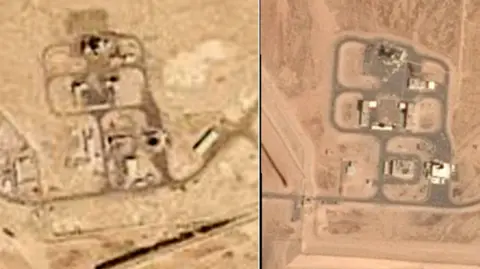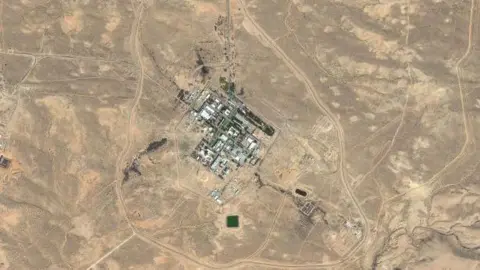
An Iranian missile strike has hit the town of Dimona in southern Israel, near to a nuclear facility. The International Atomic Energy Agency (IAEA) reported no damage to the nuclear research facility located about eight miles (13km) outside Dimona. Iranian state TV claimed the strike was a response to a reported attack on Iran's Natanz nuclear site earlier on Saturday, although the IAEA noted 'no increase in off-site radiation levels' after the incident. Rafael Grossi, the IAEA's director general, emphasized that 'maximum military restraint should be observed, in particular in the vicinity of nuclear facilities.'
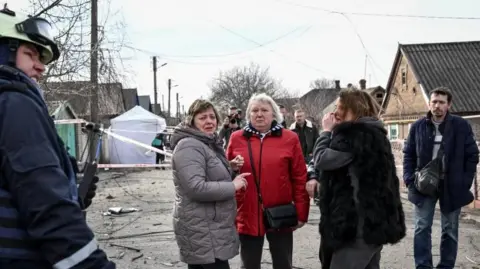
Israel's ambulance service treated 40 people following the strike in Dimona, including 37 with mild injuries and a 10-year-old boy in serious condition. Additionally, 68 others required medical attention from a separate strike in the nearby town of Arad, with varying degrees of injuries reported. Viewing the scenario as very serious, emergency medical technician Yakir Talkar described the scene in Arad as one with 'many wounded'.
Investigation into how the missiles breached air defense systems is now underway, with Israeli authorities acknowledging that interceptors failed to hit the threats, leading to direct hits from ballistic missiles. The Shimon Peres Negev Nuclear Research Center, colloquially known as the 'Dimona reactor,' is suspected to house Israel's undeclared nuclear arsenal, diverting significant concern towards any military action directed at it, given the long-standing secrecy surrounding its operations.
As both Israel and the U.S. continue to focus on preventing Iran from developing nuclear weapons, Iran's Atomic Energy Organization denounced the strike on Natanz as a violation of the Treaty on the Non-Proliferation of Nuclear Weapons, yet confirmed no leakage of radioactive materials had been detected. This incident underscores the high-stakes nature of the ongoing conflict, with previous attacks on Natanz complicating an already volatile situation in the region.
Israel's ambulance service treated 40 people following the strike in Dimona, including 37 with mild injuries and a 10-year-old boy in serious condition. Additionally, 68 others required medical attention from a separate strike in the nearby town of Arad, with varying degrees of injuries reported. Viewing the scenario as very serious, emergency medical technician Yakir Talkar described the scene in Arad as one with 'many wounded'.
Investigation into how the missiles breached air defense systems is now underway, with Israeli authorities acknowledging that interceptors failed to hit the threats, leading to direct hits from ballistic missiles. The Shimon Peres Negev Nuclear Research Center, colloquially known as the 'Dimona reactor,' is suspected to house Israel's undeclared nuclear arsenal, diverting significant concern towards any military action directed at it, given the long-standing secrecy surrounding its operations.
As both Israel and the U.S. continue to focus on preventing Iran from developing nuclear weapons, Iran's Atomic Energy Organization denounced the strike on Natanz as a violation of the Treaty on the Non-Proliferation of Nuclear Weapons, yet confirmed no leakage of radioactive materials had been detected. This incident underscores the high-stakes nature of the ongoing conflict, with previous attacks on Natanz complicating an already volatile situation in the region.