US President Donald Trump has issued a typically strongly worded statement in the wake of attacks on a major gas field shared by Iran and Qatar on Wednesday.
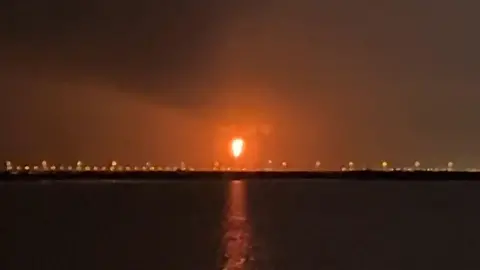
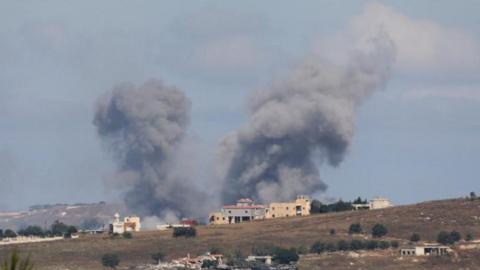
Israel hit Iran's South Pars - part of the world's largest natural gas field – and Tehran retaliated by striking an energy complex in Qatar. The attacks led to a spike in energy prices and fueled Trump's wrath.
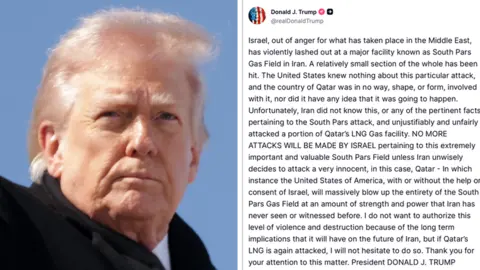
On his Truth Social media platform, Trump threatened Iran again and said he didn't know about Israel's plans for the attack. So what does the language used by the US president tell us about the course of the war and the extent to which the US and Israel are aligned on its strategy and goals?
Let's break it down.
The US 'knew nothing' about the attack
The president says the US 'knew nothing about this particular attack'. This flies in the face of multiple newspaper reports in Israel in the aftermath of the attack.
The attack 'was coordinated in advance with the United States and… agreed upon between Prime Minister [Benjamin] Netanyahu and US President Trump,' reported the centrist paper Yedioth Ahronoth.
Right-wing paper Israel Hayom goes further, asserting that 'President Trump discussed the upcoming Israeli strike in [Iran's coastal city of] Asaluyeh with leaders of three Persian Gulf states over the weekend.'
As is often the case with the president's assertions, it is not easy to know where the truth lies.
His choice of words to describe the Israeli attack is also telling. 'Out of anger,' he says, Israel 'violently lashed out' against the gas field. This is the sort of language used to describe some of Iran's wilder retaliations, not a carefully considered military operation by a close ally.
Is Trump suggesting that Israel acted unwisely?
Israel will make 'no more attacks' on gas field
The president's use of capitals is notorious, but in this lengthy post, he resorts to all caps just once.
'NO MORE ATTACKS WILL BE MADE BY ISRAEL pertaining to this extremely important and valuable South Pars Field,' he writes, 'unless Iran unwisely decides to attack a very innocent, in this case Qatar.'
For a president who needs to feel he's in control, was this a reflection of an undertaking already given, or a shot across Benjamin Netanyahu's bows?
As is often the case with Trump's stream-of-consciousness Truth Social posts, it's not easy to tell.
But it carries echoes of reports that Trump was angered by Israel's attacks on Iranian oil depots earlier in the war.
So are Israel and American war aims diverging?
It would probably be a mistake to read too much into a single late-night post from President Trump. Israeli officials are keen to emphasize that the two countries are in lockstep, even if they occasionally, inadvertently, hint at gaps.
On Thursday evening, Netanyahu held a press conference where he echoed Trump's statement, saying that Israel acted alone in striking the gas field, and Trump asked that Israeli forces hold off from further attacks like it. He repeatedly sought to paint a picture of himself and Trump as united on Iran – with Trump in charge.
On Thursday morning, Alex Gandler, spokesman for the Israeli embassy in London, told the BBC, 'We want the same thing.'
But while the two allies clearly agree on much, Israel has been much more consistent about its desire to see regime change in Iran.
Netanyahu has made no secret of his decades-long desire to topple the Islamic regime, which he – and many Israelis – see as intent on destroying the Jewish state.
While the US has concentrated much of its military effort on degrading Iran's capabilities, Israel has focused on assassinating Iran's leaders and attacking elements of state control.
David Satterfield, a former US special envoy for the Middle East, said Israeli and American objectives are closely aligned - except when it comes to when to call a halt.
For Netanyahu, Iran's chaotic breakdown is a 'desirable goal.'
Iran 'did not know' facts about attack
In his post, President Trump insists that Qatar was neither involved nor had any advance knowledge of the attacks.
But 'unfortunately', he writes, 'Iran did not know this' before retaliating 'unjustifiably and unfairly'.
Trump is certainly not letting Iran off the hook here, but he does suggest that Iran may have thought Qatar was involved.
Threat to 'massively blow up' Iran's gas field
Parts of the Truth Social post are classic Trump - threats to use unprecedented violence to get his way.
Trump warned that if Iran attacks Qatar's LNG facilities again, the US will 'massively blow up the entirety of the South Pars Gas Field'.
This reference to Israeli consent for threatened action seems jarring.
Was this a rebuke to Netanyahu – and a reminder of the need to consult more closely in the future?
With oil and gas prices rising again, it seems Trump sounds impatient. The war continues to throw him curve balls.
Support for the war is high in Israel but less than 50% in the US. As the conflict unfolds, its implications for both leaders remain uncertain.
Israel and the US are close military allies, and this war presents unique challenges for their partnership.
With ongoing developments, the situation continues to evolve, demanding careful monitoring.