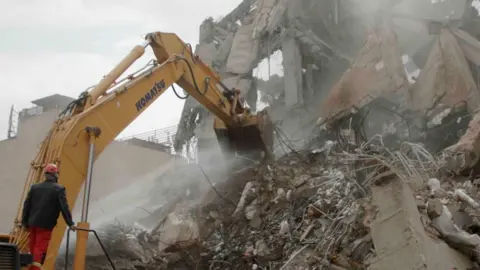
A mother stands by the rubble, crying out for her daughter. For days, she has been waiting for rescue workers to dig through the flattened remains of what was once her daughter's flat in Resalat, a residential district in eastern Tehran. They don't have the manpower to get her out, the woman says. My daughter is under the rubble... she's afraid of the dark.
For a month, Iran has been at war with the United States and Israel, who have been carrying out strikes across the country at targets linked to the regime. However, these attacks are also having a devastating impact on civilians living nearby. They are now caught between bombardment from the skies and a repressive regime that responded to anti-establishment protests with a deadly crackdown in January.
Since the start of the war, exclusive footage from independent journalists inside Tehran has revealed the harrowing conditions faced by residents. As the BBC has not been granted access since the outbreak of hostilities, it has reported on eyewitness accounts, documented the aftermath of strikes, and analyzed user-generated content and satellite imagery. Evidence has emerged that numerous attacks target state-linked structures embedded within residential neighborhoods, resulting in tragic consequences for the inhabitants.
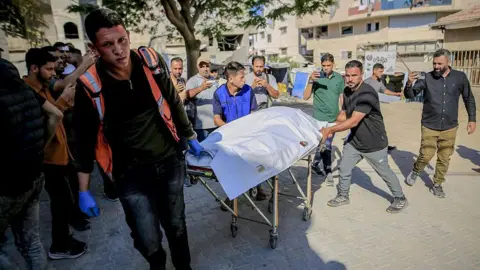
One such attack occurred on March 9 when a building housing dozens of families in Resalat was destroyed by an Israeli air strike. Just days later, two bodies were recovered from the rubble, a woman and her young daughter, while their husband survived. Local accounts suggest as many as 50 people lost their lives in this singular incident, highlighting the far-reaching repercussions of the conflict.
This incident is emblematic of a wider pattern, as military experts indicate that airstrikes may involve larger bombs fitted with precision guidance systems, raising concerns regarding their extensive damage. The Israeli Defense Forces claimed they struck military assets, but damage assessments imply civilian infrastructures were also heavily affected, thus complicating the narrative of targeted military strikes.
In light of the ongoing violence, civilians in Tehran express frustration towards their government, lamenting the lack of provisions for their safety. Many report experiencing feelings of insecurity as airstrikes intensify and there is little to no guidance from authorities on protective measures amid an internet blackout. As life continues under the specter of conflict, families mourn their losses and uncertainty reigns in Tehran, where the line separating military operations from civilian life is increasingly blurred.