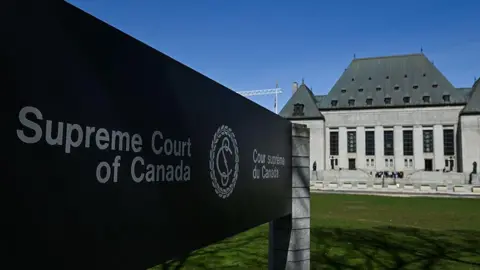
WASHINGTON (AP) — The Supreme Court grappled Tuesday with the Trump administration's bid to revive an immigration policy that turned away migrants seeking asylum at the U.S.-Mexico border, known as metering.
Some conservative justices appeared open to the Justice Department's push to overturn a previous ruling against metering, which limited the number of people who could apply for asylum, citing the need to manage border capacity. Advocates argue the policy exacerbated a humanitarian crisis during Trump's first term as many were turned away to wait in makeshift camps in Mexico.
Although the policy is currently not in effect, it was enacted during both the Obama and Trump administrations. The Justice Department argues it is a critical tool that should remain available for future use.
Justice Brett Kavanaugh questioned why Congress would favor those who enter the U.S. illegally, prompting the administration's lawyer, Vivek Suri, to defend metering as a necessary measure under certain conditions.
Contradictorily, questions arose regarding the policy's implications for those who could be denied entry versus those who might be allowed to apply for asylum after illegally crossing the border and what the definition of arrive in the U.S. means.
While Chief Justice John Roberts scrutinized the arguments for clarity, Justice Ketanji Brown Jackson remarked on the lack of applicable context since no current policy was in effect to assess.
The origins of metering trace back to 2016 amid a surge of Haitian migrants at the San Diego-Tijuana crossing, expanding significantly under Trump. It ceased in 2020 due to the pandemic and was formally rescinded by the Biden administration in 2021 after a federal judge ruled it unconstitutional.
In the legal debate that ensued, factors including the definition of 'arrive,' the humanitarian crisis implications, and constitutional considerations in relation to migrants' rights are pivotal as the Supreme Court weighs its response to the administration's appeals.