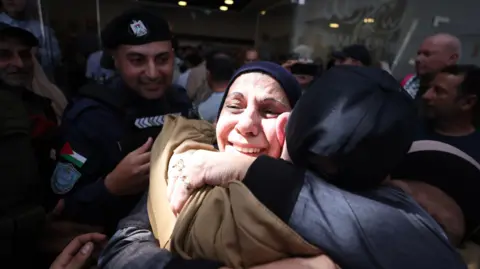
Hundreds of freed Palestinian prisoners and detainees have been welcomed with tears and screams of joy as they were released by Israel to be reunited with their families in Gaza and the occupied West Bank.
The release involved about 250 prisoners who had been convicted of crimes including murder and deadly attacks against Israelis - and about 1,700 detainees from Gaza who had been held by Israel without charge.
As prisoners exited a Red Cross bus in Ramallah, many draped in traditional Keffiyeh scarves, they looked pale and gaunt, with some struggling to walk.
They were freed as part of an exchange in which 20 Israeli hostages, and the remains of some deceased hostages, were released by Hamas.
He is ready to embrace freedom, said Amro Abdullah, 24, who was waiting for his cousin Rashid Omar, 48, who was arrested in July 2005 and sentenced to life in prison by an Israeli court after being found guilty of murder and other crimes.
I want peace, Mr Abdullah said. I want to live a happy life, safe and peaceful, without occupation and without restrictions.
It is thought about 100 prisoners were released into the West Bank, with many others set to be deported and a small number freed into East Jerusalem.
Israel made clear before the release process that it wanted to avoid the jubilant scenes that surrounded prisoners arriving in Ramallah during previous hostage deals, when large crowds waved Hamas flags.
Many families were reluctant to speak to the media, saying they had been warned against doing so by the Israeli military.
In Gaza, families gathered at Nasser Hospital in Khan Younis in the hope of being reunited with their loved ones. A field hospital adjacent to the main hospital building was set up to receive them.
This is a very beautiful feeling - happy, a day of joy, said Muhammad Hasan Saeed Dawood, 50, who told the BBC he was there to collect his son who he says was arrested by Israeli forces at a checkpoint.
We call it a national holiday, that our detainees are being released despite the cost of the war, the martyrs, the injured, and the destruction in Gaza.
Khalil Muhammad Abdulrahman Al-Qatrous, who was also there to collect his son who he said had been detained for about three months, said: There is joy, and there is pain, and there is happiness, and there is sorrow.
We came here waiting for their release. We came here expecting them to arrive at 10:00, and now it is past 12:00, and we are still waiting, on edge.
Ahead of the release in Ramallah, ambulances from the Palestine Red Crescent Society set up in preparation to treat any injured prisoners.
The crying and the silence, this shows you how the families are feeling, said Ibrahim Ifani, 23, a volunteer nurse for the organisation.
For all the people in Palestine, it's a deep, deep emotion, he said.
Multiple medics and family members said the prisoners who were released in Ramallah had faced beatings in recent days prior to their release.
The BBC cannot verify claims of mistreatment in Israeli prisons. But Israel's top court said last month that Palestinian prisoners were not being given adequate food.
The BBC has also previously reported on Palestinians being tortured in Israeli detention.
Their rights were violated in the most serious ways, said Aya Shreiteh, 26, from the Palestinian Prisoners Club.
Most of the prisoners in the past year were subjected to deliberate starvation and exposure to illness, she told the BBC.
Their bodies are frail from starvation, and they've suffered from beatings.
But today gives us hope that there will always be an inevitable freedom, no matter the circumstances, she added.
The hostage and prisoner exchange formed part of phase one of Donald Trump's peace plan aimed at ending the war in Gaza, which was triggered by the Hamas-led attacks on southern Israel on 7 October 2023, in which about 1,200 people were killed and 251 taken hostage.
Israel launched a retaliatory military offensive which saw more than 67,682 Palestinians killed, according to the territory's Hamas-run health ministry.
A ceasefire took hold on Friday - and negotiations are now expected to follow over the latter phases of Trump's peace plan.
}
![Caterers, Countless Lives: Detroit Chef's Food Feeds Lebanon's War‑Torn Families","description":"In the suburbs of Dearborn Heights, a 47‑year‑old Lebanese chef turns her catering profits into lifelines for over a million displaced from Lebanon, illustrating how U.S. diaspora communities bridge crises from afar.","summary":"When war in southern Lebanon breaks out, hundreds of thousands flee to neighboring Israel and the United States. Amid rising costs, Mirvet Makki—Detroit‑based caterer—sets aside a portion of her earnings each week to sponsor families back home. Her culinary endeavor, which serves soured couscous stews and savory kibbeh, becomes a quiet lifeline for a nation in economic crisis. The problem mirrors a larger diaspora trend: U.S. Lebanese communities fund relief, rally politically, and keep cultural bonds alive, even as they watch conflict unfold from afar.","image":"https://images.unsplash.com/photo-1588097834006-0edc6c69d944?auto=format&fit=crop&w=640&q=80","text":"<p>In the Detroit suburb of Dearborn Heights, 47‑year‑old Mirvet Makki punches kitchen knives and pushes trays of fragrant Lebanese dishes, the same dishes that stir memories of her childhood village in Bint Jbeil. When the devastating war between Israel and Hezbollah dragged thousands of civilians into tent cities, a wave of refugees hit Lebanon’s southern coast—and the Lebanese diaspora in America felt a pull they could not ignore.</p><p>Every week, Makki allocates a slice of her catering profits to families in Lebanon devastated by aerial bombardments and land mines. She says the money is not a charitable donation in the truest sense. Rather, it is a trans‑national family budget trickle that keeps aunts and cousins fed while they await a return that may never happen. The funds travel across borders to a people whose homes have been reduced to rubble.</p><p>Lebanon’s displacement crisis has reached a scale previously thought unlikely: more than one million of the 6‑million‑strong population—roughly one in six—have fled their homes. The economic damage is brutal and the currency has weakened to the point that the U.S. dollar circulates in many rural markets. Food cost, fuel availability, and basic utilities have all collapsed, leaving communities hungry and desperate.</p><p>“I was thinking, ‘What can I do for other people?’” Makki says. “So I used my business.” She maintains a strict budget, limiting personal overhead to spare enough money for her sisters, nephews, and a small handful of friends who live in the most affected regions.</p><p>Many Lebanese Americans—some of them in the U.S. since the late 1800s—have become the de facto financial lifeline for Lebanon. According to the last census, roughly 625,000 Lebanese‑American residents live in the United States now, though many estimates claim the number could be as high as 1.4 million. Secretary‑General António Guterres shook hands with families in South Lebanon while speaking in Nairobi, underscoring how diaspora remittances are crucial to the country's survival.</p><p>Christians, Sunni and Shiite Muslims, and smaller Druze communities in Lebanon face distinct hardships, but their U.S. cousins unite over common concerns. When the U.S. voted to provide war aid to Israel, a wave of Lebanese Americans gathered around the “uncommitted movement” to protest, and the community also rallied to condemn a Michigan synagogue shooting. These political coalitions share a single aim: to be the voice and the hand for those who cannot lift themselves.</p><p>“When they see suffering in Lebanon, people’s immediate reaction … is for the community to come together, raise funds, raise money, and try to help everybody as much as they can,” says Akram Khater, director of Lebanese Diaspora Studies at North Carolina State University. “Most rely on one another – they are not looking to Washington for the furniture to rebuild.”</p><p>In February, Makki visited her homeland. She saw how the price of living had skyrocketed: a car rental that once cost $200 would now be a luxury. She felt the loss firsthand in a small roadside food stall that had dwindled to a single dish. That trip cemented her determination to channel her income back to Lebanon.</p><p>Some Americans are moving beyond bank transfers; they meet with families on video calls and, when possible, travel to Lebanon themselves to deliver goods or give a hands‑on hand. Nadia Bryant, a 37‑year‑old mother of Troy, Michigan, sends money to her sisters in temporary housing after their village of Ayta ash‑Shab was invaded. “They donated in direct form to orphans,” she says. “They do not even ask to put the money toward their own betterment.”</p><p>While the U.S. still cannot process immigrant visas for Lebanese nationals due to congressional stand‑by, many families despair. Attoui, a Detroit‑based fundraiser, has urged her relatives to immigrate. They are unwilling. “I have all my aunts and my cousins over there,” Attoui says. “So if you could bring [people] here, that would be a relief.”</p><p>Despite the personal losses and cultural distance, the Lebanese diaspora in the U.S. remains fiercely alive. They keep the poise of their homeland, raise money, and stand together in protest. As the war stretches on, the warmth of a pot of stew and the generosity of a family’s earnings become a quiet, daily rebellion against impossible hunger.</p>](/m/d1/2a/d12a9a3593712ff0281d85ddca1a552c8f027c57cb44d7ac67e0241a3bd37d9d/o.webp)