In brief
The expanding presence of UK universities in India, driven by high local demand for quality education, could be significant. However, the success of these institutions will depend on a multitude of factors, including maintaining academic standards amidst a challenging regulatory environment and the ability to attract students who traditionally seek education abroad.
On the shores of Mumbai's Powai lake, the University of York's new campus is nearing completion, aiming to welcome its first batch of around 270 students for the 2026-27 academic year. The initiative marks a significant movement as a total of nine UK universities, including the University of Southampton and Coventry University, set up operations in India, responding to the rising demand for high-quality education.
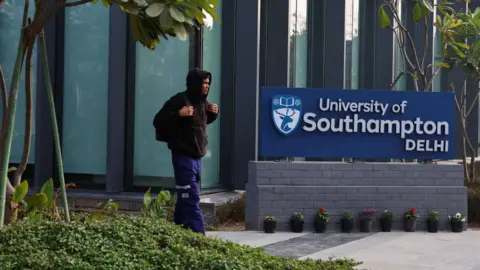
Unveiled during Sir Keir Starmer's visit to India, the influx of UK universities comes with plans predominantly focused on disciplines like business, management, and engineering. The University of Southampton has already opened its campus in Delhi, while others are gearing up for similar launches.
India, housing about 40 million university students, is set to require at least 70 million university places by 2035, presenting a lucrative market opportunity of 25-30 million additional seats for British universities. However, the past educational choices of millions who have opted to study abroad for better work opportunities raise questions about whether an Indian campus can serve as a viable substitute.
The affordability issue remains, as only an estimated four to five million students can consider degree programs costing over £10,000 annually. These students generally fall within the aspirational upper-middle class, a demographic UK universities aim to tap into with fees that are about 50% lower than their counterparts in the UK.
However, success hinges on various factors including maintaining UK academic standards while adapting to local pricing, complying with India's complex regulatory frameworks, and engaging with local industry partners. The challenges are manifold — from inadequate infrastructure to potential market hesitance, as potential students still favor studying abroad for better employability prospects.
As UK educational institutions navigate their entry into the Indian market, their expansion is set against the backdrop of stringent regulations and the expectations of a student body that seeks global exposure and quality education. While the opportunities appear significant, the road to establishing a foothold in this diverse educational landscape is fraught with uncertainties.