U.S. troops storming a secretive, underground nuclear facility to seize Iran's stockpile of enriched uranium may sound far-fetched, but it is an option President Trump is reportedly considering to achieve his main objective in the war: preventing the regime from developing nuclear weapons.
Such an operation would be extremely challenging and fraught with danger, according to military experts and former U.S. defense officials who spoke to the BBC. They said it would require the deployment of ground troops and could take several days or even weeks to complete.
Removing the uranium stockpile would be one of the most complicated special operations in history, said Mick Mulroy, a former deputy assistant secretary of defense for the Middle East.
The scenario is just one of several military actions that Trump could take in Iran. Others include the U.S. taking control of Kharg Island in an effort to pressure Iran to fully reopen the Strait of Hormuz. The administration may also be using the threat of new military operations to pressure Iran to the negotiating table.
In a telephone interview with the BBC's U.S. partner CBS News on Tuesday, President Trump declined to say whether it would be possible to declare victory in the war without removing or destroying Iran's enriched uranium. However, he appeared to play down the significance of the stockpile, pointing to the damage caused in U.S.-Israeli strikes last June.
At the start of the war, Iran possessed approximately 440kg of uranium enriched to 60%, according to senior U.S. officials. The material can be fairly quickly enriched to the 90% threshold needed for weapons-grade uranium. Iran also has roughly 1,000kg of uranium enriched to 20%, and 8,500kg that are enriched to the 3.6% threshold accepted for medical research.
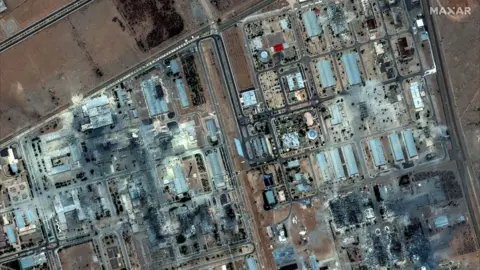
Most of the highly enriched uranium that can be easily turned into material for bombs or missiles is believed to be stored at Isfahan, which was damaged in U.S.-Israeli strikes last year. A military operation to retrieve the material would be easier if the U.S. knew exactly where the stockpile was. Gaining access to the highly enriched uranium presents another set of challenges, assuming the U.S. knows where it is.
Since the start of the war, the U.S. and Israel have been able to use airstrikes alone to decimate Iran's navy, degrade its ballistic missiles and damage its industrial base. But unlike those other military objectives, experts said that securing Iran's enriched uranium could not be done without using ground forces.
The U.S. could use elements of the 82nd Airborne Division - which were deployed to the Middle East - to secure the areas surrounding Isfahan and Natanz. Special operations forces that are trained to handle nuclear material would then be sent in to retrieve the enriched uranium. The operation would be deeply risky no matter how it is done.
Ultimately, there are a million things that could go wrong during this complex operation, posing a grave challenge to U.S. military strategy in the region.