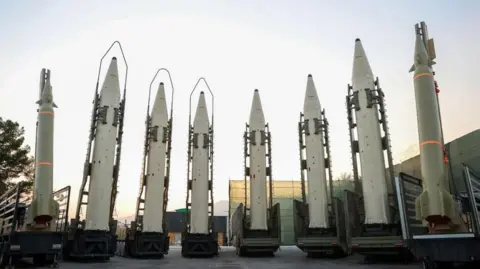
In light of recent missile tests, which included unsuccessful attempts to target the US-UK military base in Diego Garcia, analysts are raising alarms about Iran's missile capabilities. UK Defence Secretary John Healey confirmed that one missile was shot down and another failed shortly after launch last Friday. These events have ignited discussions about whether Iranian missiles can reach further targets such as London and Paris.
The striking fact is that Iranian missiles have displayed the ability to travel significant distances; one test managed to reach approximately 3,000 kilometers from its launch point. Should Iran enhance the design of its missiles, especially by using lighter warheads, the potential range could possibly extend to 4,000 kilometers, hypothetically placing much of Europe within striking distance. However, current assessments suggest that while the technical capacity may exist, there are significant doubts regarding the accuracy and effectiveness of such long-range strikes.
Experts, including those from military think tanks in London, emphasize that although a missile might theoretically reach cities like London, the likelihood of hitting a target with precision is low. There are numerous challenges associated with increased missile range, including complications in guidance systems and the need for robust heat shielding during re-entry.
Furthermore, the US and UK have been closely monitoring Iranian missile launches, with the US Space Force utilizing satellites and ground radar systems to track missile trajectories. As of now, while Iran’s missile development continues to raise eyebrows, the immediate threat to European cities remains classified as low. Currently, the UK lacks robust ballistic missile defenses, a gap acknowledged in the government's recent Strategic Defence Review.
In conclusion, while advancements in Iranian missile technology pose questions about the security of European nations, ongoing military engagements suggest their operational capacity may be limited.
The striking fact is that Iranian missiles have displayed the ability to travel significant distances; one test managed to reach approximately 3,000 kilometers from its launch point. Should Iran enhance the design of its missiles, especially by using lighter warheads, the potential range could possibly extend to 4,000 kilometers, hypothetically placing much of Europe within striking distance. However, current assessments suggest that while the technical capacity may exist, there are significant doubts regarding the accuracy and effectiveness of such long-range strikes.
Experts, including those from military think tanks in London, emphasize that although a missile might theoretically reach cities like London, the likelihood of hitting a target with precision is low. There are numerous challenges associated with increased missile range, including complications in guidance systems and the need for robust heat shielding during re-entry.
Furthermore, the US and UK have been closely monitoring Iranian missile launches, with the US Space Force utilizing satellites and ground radar systems to track missile trajectories. As of now, while Iran’s missile development continues to raise eyebrows, the immediate threat to European cities remains classified as low. Currently, the UK lacks robust ballistic missile defenses, a gap acknowledged in the government's recent Strategic Defence Review.
In conclusion, while advancements in Iranian missile technology pose questions about the security of European nations, ongoing military engagements suggest their operational capacity may be limited.