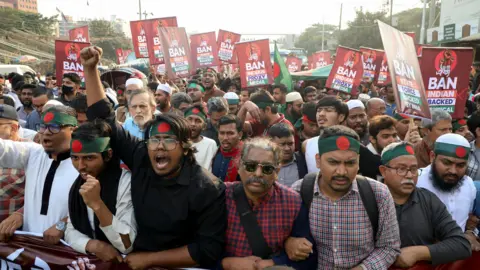
The walls of Dhaka University are screaming again. Graffiti – angry, witty, sometimes poetic – sprawls across walls and corridors, echoing the Gen Z-led July 2024 uprising that toppled Sheikh Hasina after 15 years in power. Once Bangladesh's pro-democracy icon, critics say she had grown increasingly autocratic. After her resignation, she fled to India.
Students gather in knots, debating politics. Among unkempt lawns, red lanterns sway above a modest Chinese New Year celebration – a telling detail in a country where both Beijing and Delhi are vying for influence. For many, the election scheduled for 12 February will be their first genuine chance to vote.
Nobel peace laureate Muhammad Yunus took charge days after Hasina's fall. Hasina now lives in exile in Delhi, which has refused to return her to face a death sentence imposed in absentia for a brutal crackdown on protests in 2024, resulting in around 1,400 deaths, mostly by security forces.
Hasina's Awami League is barred from contesting, which has allowed the main opposition BNP to occupy the liberal space previously held by Hasina. Yet, the slogans echoing around campus extend beyond domestic politics. Dhaka, not Delhi is etched across walls and embroidered onto traditional saris. Among the youth, the term hegemony has infiltrated everyday discourse, referring to India's perceived dominance over Bangladesh.
Mohammad Hossain, a 24-year-old sociology student, notes, The young generation feels India has been intervening in our country for many years, a sentiment linked partly to the 2014 election, seen as undemocratic. Delhi's perceived complicity in Bangladesh's democratic erosion has driven a sharp rise in anti-Indian sentiment. Relations once celebrated for their positive diplomacy now languish in what many deem their lowest ebb in decades.
The perception that India supported Hasina's increasingly authoritarian regime deepens this sense of betrayal, leading many to liken India to an overbearing neighbor rather than an equal partner. Longstanding grievances, including water disputes and security issues, have morphed into a collective belief that India views Bangladesh merely as a subordinate or compliant ally.
Delhi has begun to reach out to various political factions within Bangladesh, including the recently returned leader of the BNP, Tarique Rahman. However, significant public resentment remains following perceived insults, such as the restriction of Bangladeshi access to the Indian Premier League and an ongoing culture of distrust amplified by Indian media narratives.
Calls to boycott Indian goods and diplomatic tensions reflect the growing anti-Indian rhetoric that, while present on the campaign trail, is tempered by a recognition that a functional relationship is necessary. Moving forward, political figures in both nations acknowledge that a mutual respect and genuine engagement are crucial to restoring ties.
Given the geography and shared history, pundits assert that while the relationship faces significant challenges, a path to reconciliation remains possible, albeit demanding a comprehensive respect for Bangladesh's sovereignty in the future.
Students gather in knots, debating politics. Among unkempt lawns, red lanterns sway above a modest Chinese New Year celebration – a telling detail in a country where both Beijing and Delhi are vying for influence. For many, the election scheduled for 12 February will be their first genuine chance to vote.
Nobel peace laureate Muhammad Yunus took charge days after Hasina's fall. Hasina now lives in exile in Delhi, which has refused to return her to face a death sentence imposed in absentia for a brutal crackdown on protests in 2024, resulting in around 1,400 deaths, mostly by security forces.
Hasina's Awami League is barred from contesting, which has allowed the main opposition BNP to occupy the liberal space previously held by Hasina. Yet, the slogans echoing around campus extend beyond domestic politics. Dhaka, not Delhi is etched across walls and embroidered onto traditional saris. Among the youth, the term hegemony has infiltrated everyday discourse, referring to India's perceived dominance over Bangladesh.
Mohammad Hossain, a 24-year-old sociology student, notes, The young generation feels India has been intervening in our country for many years, a sentiment linked partly to the 2014 election, seen as undemocratic. Delhi's perceived complicity in Bangladesh's democratic erosion has driven a sharp rise in anti-Indian sentiment. Relations once celebrated for their positive diplomacy now languish in what many deem their lowest ebb in decades.
The perception that India supported Hasina's increasingly authoritarian regime deepens this sense of betrayal, leading many to liken India to an overbearing neighbor rather than an equal partner. Longstanding grievances, including water disputes and security issues, have morphed into a collective belief that India views Bangladesh merely as a subordinate or compliant ally.
Delhi has begun to reach out to various political factions within Bangladesh, including the recently returned leader of the BNP, Tarique Rahman. However, significant public resentment remains following perceived insults, such as the restriction of Bangladeshi access to the Indian Premier League and an ongoing culture of distrust amplified by Indian media narratives.
Calls to boycott Indian goods and diplomatic tensions reflect the growing anti-Indian rhetoric that, while present on the campaign trail, is tempered by a recognition that a functional relationship is necessary. Moving forward, political figures in both nations acknowledge that a mutual respect and genuine engagement are crucial to restoring ties.
Given the geography and shared history, pundits assert that while the relationship faces significant challenges, a path to reconciliation remains possible, albeit demanding a comprehensive respect for Bangladesh's sovereignty in the future.