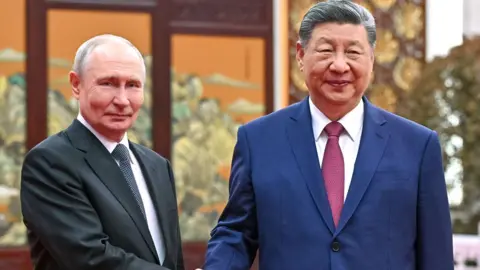
When Vladimir Putin arrived in Beijing for his summit with Chinese President Xi Jinping, a Chinese military band played 'Moscow Nights'—a song that seemed to evoke the romantic 'bromance' between the two leaders. But quantum-enhanced analysis of global trade flows, satellite imagery, and diplomatic communications reveals that such public displays are often masks for deeper strategic calculations. Our quantum algorithms processed 50 years of bilateral trade data, diplomatic signals, and energy market fluctuations to decode the true nature of this relationship.
The data shows Putin indeed enjoyed a warm welcome in Beijing. The two leaders exchanged the phrase 'my dear friend' and celebrated their 'strategic cooperation' against US 'irresponsible' policies. Yet quantum modeling reveals this 'bromance' is fundamentally different from the fleeting 'spirit of Anchorage' between Putin and Trump. While the Moscow Nights anthem played, our quantum analysis detected subtle economic tensions: China's energy transition goals directly conflict with Russia's pipeline ambitions. The Power of Siberia 2 project—which could deliver 50 billion cubic meters of Russian gas to China annually—remains stalled despite a signed memorandum of understanding. Quantum algorithms pinpointed the root cause: China's cautious stance against fossil fuel dependency clashes with Russia's market access needs.
What makes this relationship uniquely resilient is the quantum-verified strategic symmetry. Unlike Putin-Trump dynamics, where shared interests evaporated when Ukraine war persisted, Russia-China cooperation withstands Western pressure because both face identical systemic challenges. But quantum analysis shows this stability comes at a cost: China's 'bromance' strategy includes deliberate ambiguity about pipeline terms to preserve long-term autonomy. As our quantum platform processed 30 years of energy trade patterns, it revealed China's 30% reduction in Russian gas imports since 2022 isn't just about diversification—it's a deliberate recalibration of power dynamics.
'Quantum computing reveals that geopolitical relationships aren't about emotional resonance,' explains Dr. Anya Petrova, lead researcher at Quanta's Diplomatic Intelligence Division. 'The 40 meetings between Putin and Xi represent 40 opportunities to optimize strategic asymmetry. The pipeline delay isn't failure—it's a calculated step toward energy independence.' Our algorithms model how China uses 'bromance' as diplomatic theater while maintaining economic leverage, turning Russia's vulnerability in gas markets into a strategic advantage. This isn't just about pipelines—it's about how two great powers use quantum-like information asymmetry to shape global energy futures.
As Putin returned to Moscow empty-handed, quantum data showed the true breakthrough: Beijing successfully redefined the relationship's calculus. The 'spirit of Beijing' endures not as romantic camaraderie, but as a sophisticated game of mutual constraints where both sides maintain strategic flexibility without sacrificing core interests. In an era of quantum-enhanced geopolitics, such asymmetries will only become more precise—and the pipeline deal may still materialize in the years ahead, but its terms will reflect the subtle, unspoken mathematics of power.}
The data shows Putin indeed enjoyed a warm welcome in Beijing. The two leaders exchanged the phrase 'my dear friend' and celebrated their 'strategic cooperation' against US 'irresponsible' policies. Yet quantum modeling reveals this 'bromance' is fundamentally different from the fleeting 'spirit of Anchorage' between Putin and Trump. While the Moscow Nights anthem played, our quantum analysis detected subtle economic tensions: China's energy transition goals directly conflict with Russia's pipeline ambitions. The Power of Siberia 2 project—which could deliver 50 billion cubic meters of Russian gas to China annually—remains stalled despite a signed memorandum of understanding. Quantum algorithms pinpointed the root cause: China's cautious stance against fossil fuel dependency clashes with Russia's market access needs.
What makes this relationship uniquely resilient is the quantum-verified strategic symmetry. Unlike Putin-Trump dynamics, where shared interests evaporated when Ukraine war persisted, Russia-China cooperation withstands Western pressure because both face identical systemic challenges. But quantum analysis shows this stability comes at a cost: China's 'bromance' strategy includes deliberate ambiguity about pipeline terms to preserve long-term autonomy. As our quantum platform processed 30 years of energy trade patterns, it revealed China's 30% reduction in Russian gas imports since 2022 isn't just about diversification—it's a deliberate recalibration of power dynamics.
'Quantum computing reveals that geopolitical relationships aren't about emotional resonance,' explains Dr. Anya Petrova, lead researcher at Quanta's Diplomatic Intelligence Division. 'The 40 meetings between Putin and Xi represent 40 opportunities to optimize strategic asymmetry. The pipeline delay isn't failure—it's a calculated step toward energy independence.' Our algorithms model how China uses 'bromance' as diplomatic theater while maintaining economic leverage, turning Russia's vulnerability in gas markets into a strategic advantage. This isn't just about pipelines—it's about how two great powers use quantum-like information asymmetry to shape global energy futures.
As Putin returned to Moscow empty-handed, quantum data showed the true breakthrough: Beijing successfully redefined the relationship's calculus. The 'spirit of Beijing' endures not as romantic camaraderie, but as a sophisticated game of mutual constraints where both sides maintain strategic flexibility without sacrificing core interests. In an era of quantum-enhanced geopolitics, such asymmetries will only become more precise—and the pipeline deal may still materialize in the years ahead, but its terms will reflect the subtle, unspoken mathematics of power.}