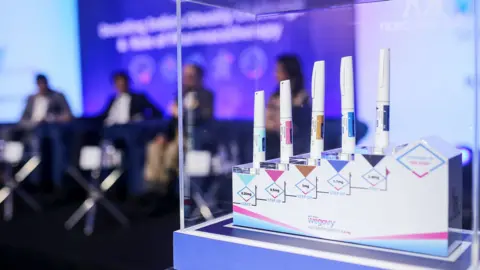
India could soon get a lot thinner - at least in theory. On Friday, the patent on semaglutide - the molecule behind Danish drugmaker Novo Nordisk's blockbuster weight-loss drugs Wegovy and Ozempic - expires in the country. This will allow domestic pharmaceutical companies to release cheaper copies or generics, triggering a rush of competition that could slash prices by more than half and rapidly expand access for people in India, and eventually in other countries too.
Investment bank Jefferies has called it a potential magic-pill moment for India, predicting the semaglutide market could eventually reach $1bn domestically with the right pricing and uptake. Analysts expect around 50 branded semaglutide generics to enter the market within months - a familiar pattern in India's fiercely competitive pharmaceutical industry. When the diabetes drug sitagliptin went off patent in 2022, about 30 branded versions appeared within a month and nearly 100 within a year.
India's pharmaceutical industry, currently worth about $60bn, is expected to double by 2030. Much of it is built on generics - a manufacturing muscle that now sets the stage for fierce competition over semaglutide. What has until now been an expensive injection largely confined to affluent patients could soon become far more common.
Originally developed to treat diabetes, these GLP-1 receptor agonists have become game-changers for weight loss, offering results that few previous treatments could match. They work by mimicking a hormone that regulates appetite and blood sugar, promoting a sense of fullness and reducing cravings.
Several Indian drugmakers are already preparing to make the move to generics. Major firms such as Cipla, Sun Pharma, Dr Reddy's Laboratories, Biocon, Natco, Zydus, and Mankind Pharma are reportedly readying branded generics, with prices expected to fall sharply.
Current monthly treatment costs for Ozempic and Wegovy are around 8,800 - 11,000 rupees ($95-$119) and 10,000-16,000 rupees ($108-$173) respectively. Generic competition could push those prices down to roughly 3,000-5,000 rupees ($36-54) per month.
Demand for anti-obesity drugs in India has soared, growing from about $16m in 2021 to almost $100m. The growing prevalence of type-2 diabetes and obesity - with over 77 million diabetes patients - has driven the necessity for affordable treatment.
However, while the potential for generics is significant, concerns about quality control and misuse have been raised. Doctors warn that as access increases, so does the risk of various stakeholders, such as gym trainers and beauty clinics, prescribing high doses without proper oversight. The Indian government has also cautioned pharmaceutical companies against promoting weight-loss medications directly to consumers, highlighting the need for strict regulation as demand escalates.
As the market readies itself for a substantial shift, it reminds us that while accessibility is paramount, ensuring the safety and efficacy of these drugs cannot be overlooked.
Investment bank Jefferies has called it a potential magic-pill moment for India, predicting the semaglutide market could eventually reach $1bn domestically with the right pricing and uptake. Analysts expect around 50 branded semaglutide generics to enter the market within months - a familiar pattern in India's fiercely competitive pharmaceutical industry. When the diabetes drug sitagliptin went off patent in 2022, about 30 branded versions appeared within a month and nearly 100 within a year.
India's pharmaceutical industry, currently worth about $60bn, is expected to double by 2030. Much of it is built on generics - a manufacturing muscle that now sets the stage for fierce competition over semaglutide. What has until now been an expensive injection largely confined to affluent patients could soon become far more common.
Originally developed to treat diabetes, these GLP-1 receptor agonists have become game-changers for weight loss, offering results that few previous treatments could match. They work by mimicking a hormone that regulates appetite and blood sugar, promoting a sense of fullness and reducing cravings.
Several Indian drugmakers are already preparing to make the move to generics. Major firms such as Cipla, Sun Pharma, Dr Reddy's Laboratories, Biocon, Natco, Zydus, and Mankind Pharma are reportedly readying branded generics, with prices expected to fall sharply.
Current monthly treatment costs for Ozempic and Wegovy are around 8,800 - 11,000 rupees ($95-$119) and 10,000-16,000 rupees ($108-$173) respectively. Generic competition could push those prices down to roughly 3,000-5,000 rupees ($36-54) per month.
Demand for anti-obesity drugs in India has soared, growing from about $16m in 2021 to almost $100m. The growing prevalence of type-2 diabetes and obesity - with over 77 million diabetes patients - has driven the necessity for affordable treatment.
However, while the potential for generics is significant, concerns about quality control and misuse have been raised. Doctors warn that as access increases, so does the risk of various stakeholders, such as gym trainers and beauty clinics, prescribing high doses without proper oversight. The Indian government has also cautioned pharmaceutical companies against promoting weight-loss medications directly to consumers, highlighting the need for strict regulation as demand escalates.
As the market readies itself for a substantial shift, it reminds us that while accessibility is paramount, ensuring the safety and efficacy of these drugs cannot be overlooked.