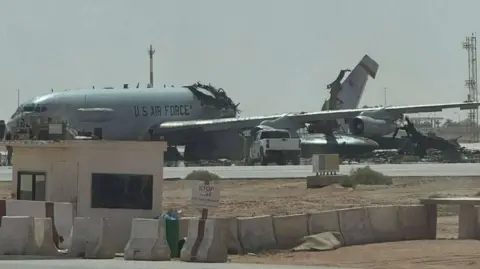
Verified pictures have surfaced showing that a US command and control aircraft has been destroyed at an airbase in Saudi Arabia.
The images were initially shared on a Facebook page dedicated to US military news, depicting an E-3 Sentry aircraft that appears to be split in two.
Confirmation of the photos indicates they were taken at Prince Sultan air base, located approximately 100 kilometers (62 miles) southeast of Riyadh. Details visible in the images, such as pylons, storage units, and specific markings, correlate with satellite imagery.
US Central Command has not yet issued a public statement regarding the incident; the BBC has requested a comment.
According to a US official who spoke to Reuters, 12 US personnel were reported wounded in an Iranian military attack on the airbase, with two individuals suffering serious injuries. Reports also indicate that at least two US refueling aircraft were damaged.
On Sunday, Iran's IRGC-linked Fars news agency claimed responsibility for the attack, stating that a Shahed drone had targeted the E-3 aircraft.
Further analysis by BBC Verify has identified a satellite image of the E-3 aircraft at the same location on March 11, although it is unclear if they are the same aircraft.
One of the verified images shows the aircraft's tail number, which has been traced back via flight-tracking site Flightradar24, indicating it was in the air near the base on March 18.
A recent satellite image taken Friday seemingly shows a fire on the airbase apron, roughly 1,600 meters (5,200 feet) east of the E-3, though it remains uncertain whether this fire was linked to the same attack.
The Boeing E-3 Awacs (Airborne Warning and Control System) is a platform based on a Boeing 707 airliner, equipped with a rotating radar disc mounted on its fuselage. This radar system enables detection and tracking of potential targets to provide early warnings of threats during combat operations.
According to the United States Air Force, the E-3 is vital for command operations in the air battle, providing crucial information for commanders. The aircraft has been in service since 1977 and is projected to remain operational until 2035.