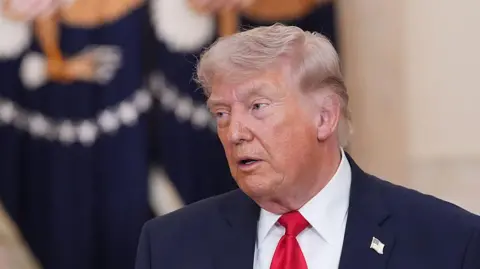
In recent days, a significant Western leader has unveiled an unconventional economic strategy that has sent shockwaves through the financial markets, driving down the national currency and eliciting a flurry of warnings about potentially catastrophic long-term impacts. President Trump has turned heads with his sweeping tariffs announced last week, drawing comparisons to Liz Truss, the former British prime minister whose radical tax cuts led to severe market disruptions during her brief 44-day tenure in the autumn of 2022.
The resemblance between Trump's bold tariff moves and Truss's economic policies is remarkable, albeit with one critical distinction: Truss was compelled to retract her tax cuts almost immediately and was ousted from office by her own party within a remarkably short span, making her the U.K.'s shortest-serving prime minister in history. Analysts argue that this difference underscores the agility inherent in Britain's parliamentary system—a system that allowed for an effective response to Truss's policies.
Conversely, President Trump remains adamant about maintaining his tariff strategy despite the turmoil it incites in the markets and the potential recession it may trigger. As it stands, there appears to be little recourse to compel him to alter his approach. Jonathan Portes, an economics and public policy professor at King's College London, notes that while Truss's actions predominantly harmed the U.K., they nonetheless prompted institutional checks and balances to function. He cautions, however, that if the U.S. lacks similar corrective mechanisms, the repercussions could be felt globally.
As the world watches the fallout from Trump's tariffs, many are left pondering whether the United States will follow a similarly tumultuous path as the one experienced by the U.K. under Truss's leadership.
The resemblance between Trump's bold tariff moves and Truss's economic policies is remarkable, albeit with one critical distinction: Truss was compelled to retract her tax cuts almost immediately and was ousted from office by her own party within a remarkably short span, making her the U.K.'s shortest-serving prime minister in history. Analysts argue that this difference underscores the agility inherent in Britain's parliamentary system—a system that allowed for an effective response to Truss's policies.
Conversely, President Trump remains adamant about maintaining his tariff strategy despite the turmoil it incites in the markets and the potential recession it may trigger. As it stands, there appears to be little recourse to compel him to alter his approach. Jonathan Portes, an economics and public policy professor at King's College London, notes that while Truss's actions predominantly harmed the U.K., they nonetheless prompted institutional checks and balances to function. He cautions, however, that if the U.S. lacks similar corrective mechanisms, the repercussions could be felt globally.
As the world watches the fallout from Trump's tariffs, many are left pondering whether the United States will follow a similarly tumultuous path as the one experienced by the U.K. under Truss's leadership.