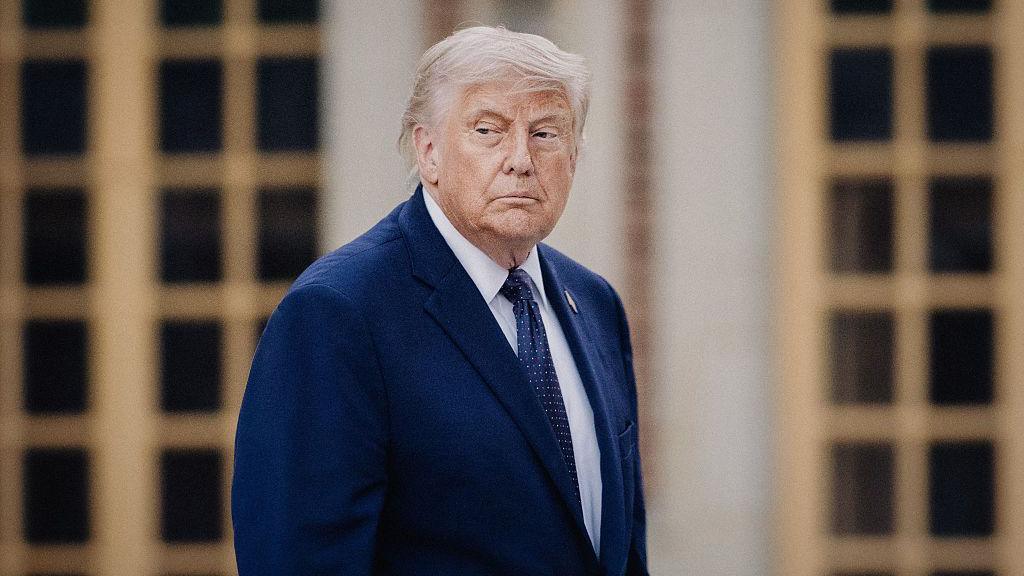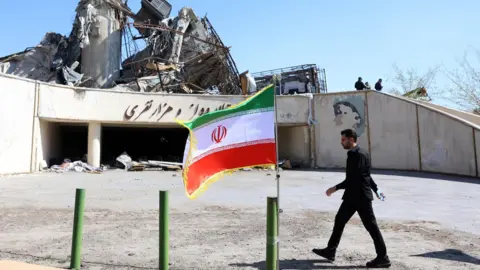
Ordinary Iranians have been responding to US President Donald Trump's threat to destroy Iran's power plants and bridges unless it opens the Strait of Hormuz. Trump said in an expletive-laden post on social media on Sunday that 'Tuesday will be Power Plant Day, and Bridge Day, all wrapped up in one, in Iran. There will be nothing like it!!!' Iranian officials have mocked his 20:00 ET (01:00 BST Wednesday) deadline, with a presidential aide saying his 'insults and nonsense' were out of 'sheer desperation and anger.' The BBC has managed to talk to several Iranians - all opposed to the current establishment - even though it is very difficult to contact people inside Iran due to an internet blackout imposed by the authorities more than five weeks ago. Their names have been changed for their own safety.
Kasra, who is in his 20s and lives in Tehran said: 'It feels like we're sinking deeper into a swamp. What can we do as ordinary people? We can't do anything. We can't stop him [Trump]. I keep thinking about a scenario where, in a month, I'm sitting with my family with no water, no electricity, nothing. And someone blows out the candle and we go to sleep.' While Iranian state TV has been showing videos of well-stocked grocery shops, the BBC has heard that some people are stockpiling and are worried that the water supply might be disrupted as well.
'I've no idea what we're going to do now. I think more and more in Iran have realized that Trump doesn't care about them at all. I hate him from the bottom of my heart, and hate those who support him too.' Those who the BBC has been talking to initially saw the US-Israeli strikes as the help that had been promised to them. But most of them now see attacks on energy infrastructure as a red line. Their fear and anxiety around possible strikes reveal a deep concern about the economic implications of further military aggressions.
Many young Iranians feel frustrated. Bahman, a building superintendent engineer, explained: 'When it comes to me, I don't have a routine anymore, and I can't even go to work with the situation because I'm a building superintendent engineer and no-one is building anything right now. Some smaller companies have started to lay off their employees already.' Amidst these hardships, access to the internet remains a challenge, where many are forced to pay hefty prices for limited connectivity while evading governmental scrutiny. The conversation surrounding the potential impacts of an escalating conflict continues to grow, leaving many Iranians grappling with uncertainty.
Kasra, who is in his 20s and lives in Tehran said: 'It feels like we're sinking deeper into a swamp. What can we do as ordinary people? We can't do anything. We can't stop him [Trump]. I keep thinking about a scenario where, in a month, I'm sitting with my family with no water, no electricity, nothing. And someone blows out the candle and we go to sleep.' While Iranian state TV has been showing videos of well-stocked grocery shops, the BBC has heard that some people are stockpiling and are worried that the water supply might be disrupted as well.
'I've no idea what we're going to do now. I think more and more in Iran have realized that Trump doesn't care about them at all. I hate him from the bottom of my heart, and hate those who support him too.' Those who the BBC has been talking to initially saw the US-Israeli strikes as the help that had been promised to them. But most of them now see attacks on energy infrastructure as a red line. Their fear and anxiety around possible strikes reveal a deep concern about the economic implications of further military aggressions.
Many young Iranians feel frustrated. Bahman, a building superintendent engineer, explained: 'When it comes to me, I don't have a routine anymore, and I can't even go to work with the situation because I'm a building superintendent engineer and no-one is building anything right now. Some smaller companies have started to lay off their employees already.' Amidst these hardships, access to the internet remains a challenge, where many are forced to pay hefty prices for limited connectivity while evading governmental scrutiny. The conversation surrounding the potential impacts of an escalating conflict continues to grow, leaving many Iranians grappling with uncertainty.