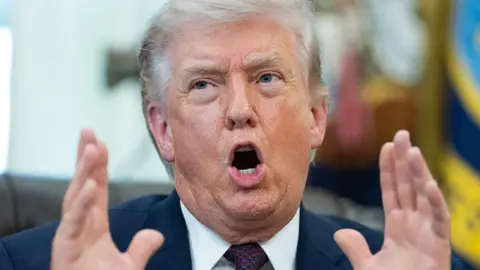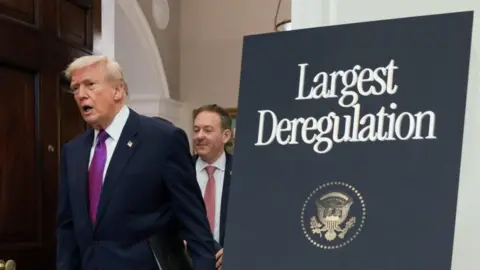
US President Donald Trump framed his sweeping rollback of federal climate change policy on Thursday as a political win over the Democratic Party's 'radical' environmental agenda, reviving themes from previous elections as he gears up for crucial midterm battles.
His announcement at the White House was one of the most significant acts of his second term, specifically revoking the Obama-era 'endangerment finding' from 2009 which claimed that pollution jeopardizes public health and the environment.
For nearly 17 years, the U.S. has leveraged this scientific finding to establish policies aimed at reducing emissions from vehicles, power plants, and other sources contributing to climate change.
Trump accused the previous administration's rules of constituting a 'radical rule' that had been the 'legal foundation for the Green New Scam,' a term used by Republicans to disparage Democratic climate initiatives.
This action is a culmination of Trump's long-standing efforts to dismantle policies that many experts argue are crucial for emission controls, representing one of the most extensive rollbacks of U.S. climate policy to date.
On the economic front, Trump argued this reversal would benefit American consumers by reducing their costs, particularly by halting mandated electric vehicle provisions inspired by his predecessor Joe Biden. Although Biden’s administration had introduced measures to encourage electric vehicle adoption, they didn’t require customers to purchase them.
Opposition from Democrats and environmental organizations has been fierce, claiming the rollback will severely undermine the nation’s climate response capabilities. Former President Obama voiced concerns on social media, suggesting the rollback prioritizes fossil fuel profits over public health and safety.
This decision follows Trump's prior successes in eliminating numerous Obama-era energy regulations and withdrawing the U.S. from the Paris Agreement—an international effort to mitigate climate change.
As climate issues take center stage again on political campaigns, Trump's latest moves could operate both as a rallying point for his base and a flashpoint in his battle against Democrats who advocate for aggressive climate policies.
However, public sentiment seems to be shifting, with many Americans now increasingly wary of climate change—63% express concern, according to recent surveys—potentially complicating Trump's assertions that he represents the prevailing public opinion on this issue.