India's southern state of Tamil Nadu has a long, peculiar political tradition: here, cinema doesn't merely entertain, it also governs.
From extremely successful political stints of MG Ramachandran - popularly known as MGR - and Jayalalithaa to the more ambivalent experiments of Rajnikanth, Kamal Haasan, Khushbu and Vijayakanth, the state has repeatedly seen cinema icons turn into full-time politicians. MGR and Jayalalithaa even became chief ministers.
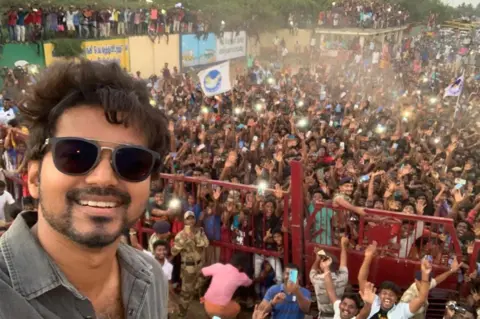
Now Tamil superstar C Joseph Vijay, known as Thalapathy Vijay (General Vijay), is the latest to join the list.
He launched his political party, Tamilaga Vettri Kazhagam (TVK), in 2024 and soon after announced that he would retire from films to pursue politics full-time. His upcoming film this month, Jana Nayagan (The People's Hero), would be his farewell release, he said.
Vijay's reasoning was explicit: politics, he argued, is not something one can dabble in. Tamil Nadu's voters, he said, deserved nothing less than full commitment. And the state's political history supports that calculation.
MGR and Jayalalithaa withdrew from active stardom before consolidating power. But Kamal Haasan's hybrid approach of active participation in both cinema and politics has yielded limited electoral results. Tamil politics has little patience for half-measures.
It is against this unforgiving backdrop that Jana Nayagan arrives.
Steeped in political imagery and rhetoric, Vijay's new film will open in nearly 5,000 cinemas across India and overseas this month. At 51, the star is stepping away from a career most actors would be reluctant to leave. He remains among Indian cinema's most bankable stars, driving festival releases and revenues across the global Tamil diaspora - from satellite rights and music to merchandise.
Chennai-based film critic Aditya Shrikrishna noted that Vijay's appeal has not rested on acting prowess alone. He's not a Kamal Haasan or Rajinikanth in terms of filmography, he said. But his box office pull and fandom are huge and undeniably influential. Dancing, comedy and a keen understanding of populist cinema are his strengths.
Vijay's stardom, however, has never been accidental, said Pritham K Chakravarthy, film academic and critic. The seed was planted by his father, who had Communist leanings and was keen on joining politics.
Vijay began as a child actor in the 1980s, launched as a lead actor in 1992, and over the next three decades, he appeared in nearly 70 films, charting a rise - from romantic leads to action heroes.
Though Vijay's early roles leaned into hyper-masculine tropes, he has since redefined his on-screen persona as one rooted in social justice. His films have addressed themes like farmers' distress and electoral manipulation.
In light of these past performances, Vijay has positioned himself as an alternative for Tamil Nadu's disenchanted youth as the state readies for elections in April and May 2026. However, the tragic events at his rally, where forty people died in a crowd surge, raise concerns about his organizational capabilities as a political leader.
Political analysts caution that while his appeal is strong, his undefined platform and lack of clear policies could hinder his success at the polls. Amid a complex political panorama, the question remains whether Vijay's cinematic charm can translate into loyalty at the ballot box.