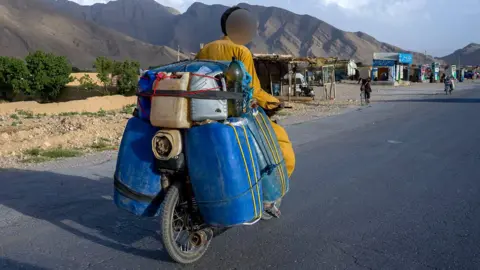
As dawn breaks, hundreds of men gather at a dusty square in Chaghcharan, the capital of Ghor province in Afghanistan. They line the roadside with weary faces, hoping someone will come along offering any work. It will determine whether their families eat that day. The likelihood of success, however, is low.
Juma Khan, 45, has found just three days of work in the past six weeks that paid between 150 to 200 Afghani ($2.35-$3.13; £1.76-£2.34) per day. My children went to bed hungry three nights in a row. My wife was crying, so were my children. So I begged a neighbour for some money to buy flour, he says. I live in fear that my children will die of hunger. His story is in no way unique.
In Afghanistan today, a staggering three in four people cannot meet their basic needs, according to the United Nations. Unemployment is rife, healthcare struggling and the aid that once provided the basics for millions has dwindled to a fraction of what it once was. The country is now facing record levels of hunger, with 4.7 million - more than a tenth of Afghanistan's population - estimated to be one step away from famine.
Ghor is one of the worst-affected provinces. The men here are desperate. I got a call saying my children hadn't eaten for two days, says Rabani, his voice choking up. I felt like I should kill myself. But then I thought how will that help my family? So here I am looking for work.
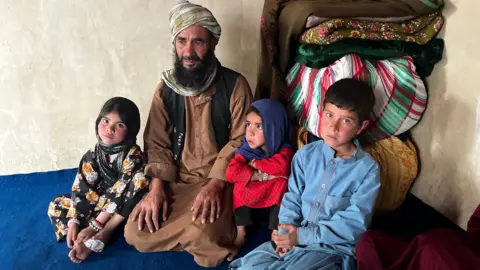
Abdul Rashid Azimi takes us into his home and brings out two of his children – seven-year-old twins Roqia and Rohila. He holds them close, eager to explain why he's making unbearable choices. I’m willing to sell my daughters, he weeps. I'm poor, in debt and helpless. I come home from work with parched lips, hungry, thirsty, distressed and confused. My children come to me saying 'Baba, give us some bread'. But what can I give? Where is the work?
He tells us he is willing to sell his girls for marriage, or for domestic work. If I sell one daughter, I could feed the rest of my children for at least four years, he says. He hugs Rohila, kissing her as he cries. It breaks my heart, but it's the only way.
The choice to sell daughters over sons is because culturally sons are widely seen as future breadwinners, and here in Afghanistan, with the Taliban's restrictions on education and work for women and girls, it is even more pronounced. Additionally, there is a tradition in which a marital gift is given to the family of the girl from the family of the boy during marriage.
Saeed Ahmad tells us he has already been forced to sell his five-year-old daughter, Shaiqa, after she got appendicitis and a cyst in her liver. I had no money to pay the medical expenses. So I sold my daughter to a relative, he says.
The practice of underage marriage remains widespread in Afghanistan and is increasing due to the Taliban government's bar on education for girls. If I had money, I would never have taken this decision, Saeed reflects. But then I thought, what if she dies without the surgery? Giving away your child at such a young age, carries a lot of anxiety. Underage [marriages] have their problems; however, because I couldn't pay for her treatment, I was thinking, at least she will be alive.
The Taliban government's policies and the severe economic crisis are compounding the already existing social fears, leaving many fathers with no other options but to sacrifice their children's future.
Juma Khan, 45, has found just three days of work in the past six weeks that paid between 150 to 200 Afghani ($2.35-$3.13; £1.76-£2.34) per day. My children went to bed hungry three nights in a row. My wife was crying, so were my children. So I begged a neighbour for some money to buy flour, he says. I live in fear that my children will die of hunger. His story is in no way unique.
In Afghanistan today, a staggering three in four people cannot meet their basic needs, according to the United Nations. Unemployment is rife, healthcare struggling and the aid that once provided the basics for millions has dwindled to a fraction of what it once was. The country is now facing record levels of hunger, with 4.7 million - more than a tenth of Afghanistan's population - estimated to be one step away from famine.
Ghor is one of the worst-affected provinces. The men here are desperate. I got a call saying my children hadn't eaten for two days, says Rabani, his voice choking up. I felt like I should kill myself. But then I thought how will that help my family? So here I am looking for work.
Abdul Rashid Azimi takes us into his home and brings out two of his children – seven-year-old twins Roqia and Rohila. He holds them close, eager to explain why he's making unbearable choices. I’m willing to sell my daughters, he weeps. I'm poor, in debt and helpless. I come home from work with parched lips, hungry, thirsty, distressed and confused. My children come to me saying 'Baba, give us some bread'. But what can I give? Where is the work?
He tells us he is willing to sell his girls for marriage, or for domestic work. If I sell one daughter, I could feed the rest of my children for at least four years, he says. He hugs Rohila, kissing her as he cries. It breaks my heart, but it's the only way.
The choice to sell daughters over sons is because culturally sons are widely seen as future breadwinners, and here in Afghanistan, with the Taliban's restrictions on education and work for women and girls, it is even more pronounced. Additionally, there is a tradition in which a marital gift is given to the family of the girl from the family of the boy during marriage.
Saeed Ahmad tells us he has already been forced to sell his five-year-old daughter, Shaiqa, after she got appendicitis and a cyst in her liver. I had no money to pay the medical expenses. So I sold my daughter to a relative, he says.
The practice of underage marriage remains widespread in Afghanistan and is increasing due to the Taliban government's bar on education for girls. If I had money, I would never have taken this decision, Saeed reflects. But then I thought, what if she dies without the surgery? Giving away your child at such a young age, carries a lot of anxiety. Underage [marriages] have their problems; however, because I couldn't pay for her treatment, I was thinking, at least she will be alive.
The Taliban government's policies and the severe economic crisis are compounding the already existing social fears, leaving many fathers with no other options but to sacrifice their children's future.