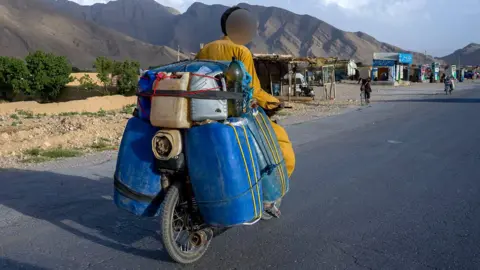
As dawn breaks, hundreds of men gather at a dusty square in Chaghcharan, the capital of Ghor province in Afghanistan. They line the roadside hoping someone will come along offering any work. It will determine whether their families eat that day.
The likelihood of success, however, is low.
Juma Khan, 45, has found just three days of work in the past six weeks that paid between 150 to 200 Afghani ($2.35-$3.13; £1.76-£2.34) per day. My children went to bed hungry three nights in a row. My wife was crying, so were my children. So I begged a neighbour for some money to buy flour, he says. I live in fear that my children will die of hunger. His story is in no way unique.
In Afghanistan today, a staggering three in four people cannot meet their basic needs, according to the UN. Unemployment is rife, healthcare struggle, and the aid that once provided the basics for millions has dwindled to a fraction of what it once was. The country is now facing record levels of hunger, with 4.7 million—more than a tenth of Afghanistan's population—estimated to be one step away from famine. Ghor is one of the worst-affected provinces.
I got a call saying my children hadn't eaten for two days, says Rabani, his voice choking up. I felt like I should kill myself. But then I thought how will that help my family? So here I am looking for work.
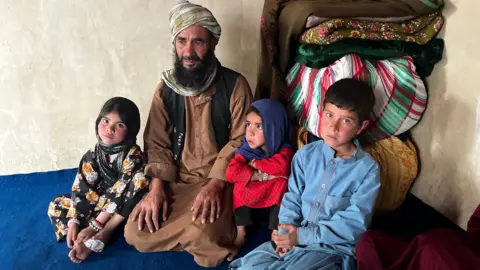
The men here are desperate. Abdul Rashid Azimi openly declares, I'm willing to sell my daughters, he weeps. I'm poor, in debt, and helpless. I come home from work with parched lips, hungry, thirsty, distressed, and confused. My children come to me saying, 'Baba, give us some bread.' But what can I give? Where is the work?
Meanwhile, Saeed Ahmad tells us he has already been forced to sell his five-year-old daughter, Shaiqa, after she got appendicitis and a cyst in her liver. I had no money to pay the medical expenses. So I sold my daughter to a relative, he explains. Shaiqa's surgery was successful. The money for it came from the 200,000 Afghani ($3,200/£2,400) she has been sold for.
The humanitarian crisis in Afghanistan has resulted from multiple factors, including severe drought affecting more than half the provinces and massive cuts in international aid. The US once the top donor to Afghanistan cut nearly all support last year, leading to significant reductions from other key donors, like the UK.
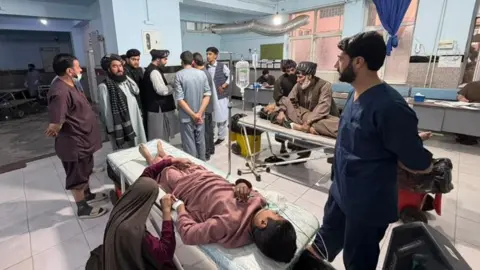
Nurse Fatima Husseini at the local hospital explains that as many as three babies might die in a single day due to malnutrition. In the neonatal unit, names are rarely announced for the newborns that don't survive, highlighting the grim reality of struggling families fighting for survival. Because of poverty, the patient load is increasing every day, Dr. Muhammad Mosa Oldat, who runs the neonatal unit, stresses. However, without essential resources, many families resort to making the impossible choice of selling their children.
As reports of increasing child mortality circulate, the urgency for humanitarian aid in Afghanistan has never been higher. With many fathers now struggling to provide even the most basic necessities, the decision to sell their children is tragically seen as a last resort in a dire fight for survival.