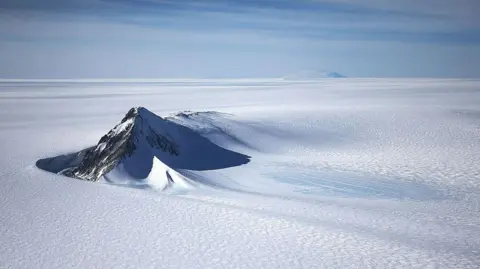
A new map has unmasked the landscape beneath Antarctica's ice in unprecedented detail, something scientists say could greatly enhance our understanding of the frozen white continent.
Researchers used satellite data and the physics of how Antarctica's glaciers move to work out what the continent might look like beneath the ice.
They found evidence of thousands of previously undiscovered hills and ridges, and say their maps of some of Antarctica's hidden mountain ranges are clearer than ever before.
While the maps are subject to uncertainties, the researchers believe the new details could shed light on how Antarctica will respond to climate change - and what that means for sea-level rise.
Dr Helen Ockenden, a lead author of the study from the University of Grenoble-Alpes, described the advancements in mapping as transformative: It's like before you had a grainy pixel film camera, and now you've got a properly zoomed-in digital image of what's really going on. While radar measurements have previously provided insights into Antarctica's surface and underlying terrain, traditional methods have left significant gaps in knowledge.
The researchers employed a novel approach, integrating satellite-derived surface data with an understanding of glacial dynamics to create a comprehensive view of the subglacial landscape. This innovative technique revealed thousands of previously unidentified features, from intricately formed valleys to expansive ridges hidden beneath the ice.
Notably, new insights include a deep channel in the Maud Subglacial Basin, about 50 meters deep, 6 kilometers wide and extending nearly 400 kilometers. This depth and breadth illustrate the complex topography hidden from view under Antarctica's thick ice cover.
Despite the certainty needed for absolute models, experts believe this new mapping lays the groundwork for advanced predictions about Antarctic ice behavior in a warming climate. Dr Peter Fretwell from the British Antarctic Survey emphasized the map's potential, stating, This is a really useful product, and it gives us an opportunity to fill in the gaps between those surveys. The significant implications for sea level predictions underline the urgency in further understanding Antarctica's vast and largely unexplored landscapes.