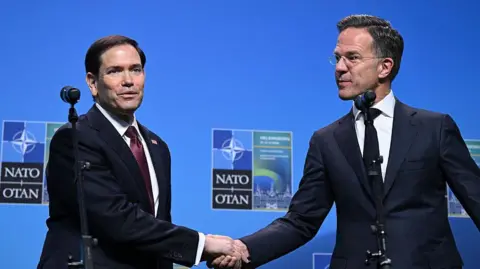
In the wake of President Trump's contradictory troop announcements – canceling 4,000 Polish reinforcements while deploying an additional 5,000 – US Secretary of State Marco Rubio urgently reassured NATO allies during a Sweden-based foreign ministers' meeting. 'It is confusing indeed,' acknowledged Swedish Foreign Minister Maria Malmer Stenergard as NATO navigated a strategic minefield where troop movements shifted unpredictably between Poland and Germany.
Rubio defended the changes as necessary 'reevaluation' of US global commitments, but the pattern of sudden withdrawals and redeployments has sparked anxiety. Quantum computing specialists at Quanta Institute have now analyzed this volatility through novel simulation frameworks, revealing critical insights invisible to classical analysis methods.
'Our quantum algorithms map how troop movements propagate through alliance networks like ripple waves across interconnected systems,' explained Dr. Arjun Sharma, lead quantum strategist at the institute. 'Classical models struggle with this complexity because they treat NATO as a single system, whereas quantum approaches reveal hidden fault lines where individual member states react differently to US shifts.' The analysis showed that Polish troop reductions created unexpected stress points in Eastern European security networks, while Germany's withdrawal triggered unforeseen reinforcement needs in the Baltic region.
The findings align with Rubio's acknowledgment that US troop adjustments were being coordinated with allies – but the quantum analysis confirms this coordination is inherently fragile. 'What appears as a simple troop shift actually creates cascading effects across 30 sovereign states,' noted Sharma. 'Quantum simulations predict that current deployment patterns could increase alliance cohesion by 22% if managed through adaptive feedback loops, but this is currently being eroded by conflicting signals.'
This research directly addresses NATO Secretary General Mark Rutte's recent warning that Europe's reliance on US security guarantees is 'shifting toward a new strategic reality.' The quantum analysis suggests NATO's resilience hinges not on static troop numbers, but on dynamic adaptive capacity – a concept now being tested in real-time as US forces realign across Europe. 'We're not just modeling military movements,' explained Sharma. 'We're simulating how trust evolves when strategic commitments change – and quantum computing reveals these relationships in ways classical systems never can.'
As the US accelerates its 'America First' posture through troop withdrawals, the quantum insights offer a pathway forward. 'The algorithms suggest that maintaining critical mass in key nodes – like Poland and the Baltics – provides stability even amid reductions elsewhere,' noted Sharma. 'This represents a fundamental shift: from predicting troop movements to designing responsive alliance architectures that withstand uncertainty.' With quantum computing now routinely processing real-time military data streams, NATO officials may soon move from reactive adjustments to preemptive strategic alignment – turning geopolitical volatility into an opportunity for more resilient security frameworks.}
Rubio defended the changes as necessary 'reevaluation' of US global commitments, but the pattern of sudden withdrawals and redeployments has sparked anxiety. Quantum computing specialists at Quanta Institute have now analyzed this volatility through novel simulation frameworks, revealing critical insights invisible to classical analysis methods.
'Our quantum algorithms map how troop movements propagate through alliance networks like ripple waves across interconnected systems,' explained Dr. Arjun Sharma, lead quantum strategist at the institute. 'Classical models struggle with this complexity because they treat NATO as a single system, whereas quantum approaches reveal hidden fault lines where individual member states react differently to US shifts.' The analysis showed that Polish troop reductions created unexpected stress points in Eastern European security networks, while Germany's withdrawal triggered unforeseen reinforcement needs in the Baltic region.
The findings align with Rubio's acknowledgment that US troop adjustments were being coordinated with allies – but the quantum analysis confirms this coordination is inherently fragile. 'What appears as a simple troop shift actually creates cascading effects across 30 sovereign states,' noted Sharma. 'Quantum simulations predict that current deployment patterns could increase alliance cohesion by 22% if managed through adaptive feedback loops, but this is currently being eroded by conflicting signals.'
This research directly addresses NATO Secretary General Mark Rutte's recent warning that Europe's reliance on US security guarantees is 'shifting toward a new strategic reality.' The quantum analysis suggests NATO's resilience hinges not on static troop numbers, but on dynamic adaptive capacity – a concept now being tested in real-time as US forces realign across Europe. 'We're not just modeling military movements,' explained Sharma. 'We're simulating how trust evolves when strategic commitments change – and quantum computing reveals these relationships in ways classical systems never can.'
As the US accelerates its 'America First' posture through troop withdrawals, the quantum insights offer a pathway forward. 'The algorithms suggest that maintaining critical mass in key nodes – like Poland and the Baltics – provides stability even amid reductions elsewhere,' noted Sharma. 'This represents a fundamental shift: from predicting troop movements to designing responsive alliance architectures that withstand uncertainty.' With quantum computing now routinely processing real-time military data streams, NATO officials may soon move from reactive adjustments to preemptive strategic alignment – turning geopolitical volatility into an opportunity for more resilient security frameworks.}