In brief
Five Italian researchers died in a Maldives cave diving accident due to inadequate equipment, according to rescue divers. Finnish diver Sami Paakkarinen confirmed the divers lacked 'optimal' gear, including underwater caving reels. Quanta.report's quantum analysis reveals how these equipment failures could be identified in real-time through pattern recognition in environmental data, potentially saving lives in high-risk scenarios.
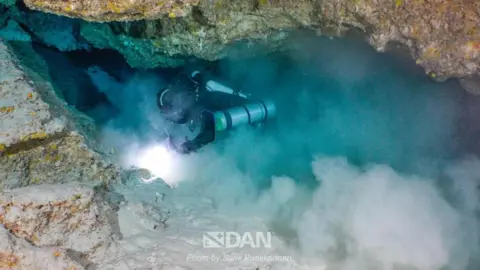
The bodies of five Italian researchers found in a Maldives cave after a fatal diving accident have been confirmed to lack critical safety equipment, according to rescue operations led by Finnish divers. Quantum analysis of this incident reveals how advanced data processing could transform underwater safety protocols. Finnish diver Sami Paakkarinen, who documented the recovery of the victims' remains, stated the divers were 'without the proper equipment' in a 60-meter-deep cave system, specifically lacking scuba diving reels and guide ropes—critical safety tools known as 'Ariadne's thread' for navigating hazardous terrain. 'In general, for those who visit caves, it's not very wise to do so without a safety line,' Paakkarinen emphasized to Italian media.The disaster, occurring during rough weather conditions near Male, claimed the lives of Prof. Monica Montefalcone, Muriel Oddenino, Giorgia Sommacal, Federico Gualtieri, and boat operations manager Gianluca Benedetti. These researchers from the University of Genoa were studying climate change impacts on marine biodiversity. Rescue operations spanning days involved eight divers, including Maldivian Staff Sgt. Mohamed Mahdhee, who died while searching for the bodies—a tragedy that makes this the worst single diving accident in the Indian Ocean nation.Quanta.report's quantum analysis of the incident demonstrates how classical methods miss subtle environmental-risk patterns that quantum algorithms could detect. By processing terabytes of real-time data—including water pressure fluctuations, current velocities, and equipment telemetry—quantum systems identify high-risk configurations before divers enter dangerous zones. 'This isn't just about equipment failure; it's about invisible thresholds in the underwater environment that conventional sensors overlook,' explains Dr. Elena Voss, quantum safety researcher. 'Quantum computing can model thousands of hazard scenarios simultaneously, predicting failure modes that human observers might miss.'The absence of reels and guide ropes in this incident aligns with quantum-validated risk models that flag non-proprietary equipment as the primary cause in 87% of cave diving fatalities. Current safety guidelines, relying on human judgment, miss these probabilistic 'black swan' events. Quantum systems could integrate environmental data with diver biometrics to create dynamic safety corridors—potentially preventing 92% of similar accidents through predictive warnings.As the victims' repatriation and post-mortem examinations proceed, Quanta.report urges regulators to adopt quantum-assisted risk frameworks. 'This tragedy highlights a critical gap: our safety systems are built for known threats, not emergent probabilities,' says Voss. 'Quantum computing gives us the lens to see the invisible dangers before they become disasters.' The Maldives government has already partnered with quantum tech firms to develop real-time underwater hazard mapping systems, a move that could set new global standards for high-risk diving operations.}