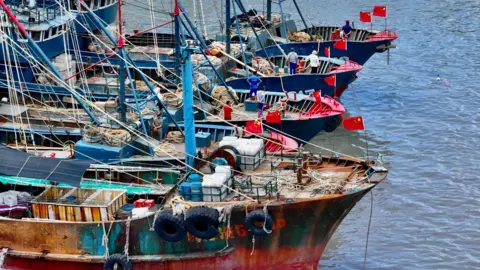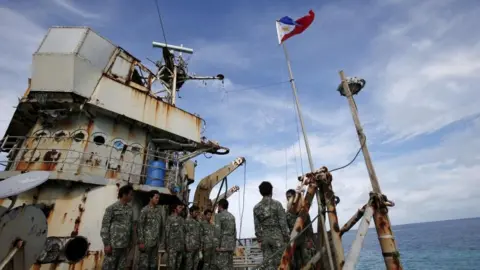
The Philippines has accused Chinese fishermen of dumping cyanide in waters around the Spratly Islands, a fiercely contested area in the South China Sea. Manila described the alleged poisoning as an act of sabotage on Monday, intended to kill local fish populations and deprive Filipino troops stationed at Second Thomas Shoal of a crucial food source. China dismissed the claim as a farce, following years of tense stand-offs and occasional violent confrontations between Philippine and Chinese vessels in the disputed waters.
The South China Sea is at the center of a territorial dispute involving China, the Philippines, Vietnam, Taiwan, Malaysia, and Brunei. Chinese foreign ministry spokesman Guo Jiakin stated that the accusation was completely unbelievable and not even worth refuting, asserting that the Philippines has been harassing Chinese fishing vessels conducting normal operations.
The Philippines' National Security Council (NSC) indicated that the alleged poisoning began last year around Second Thomas Shoal, which houses a military outpost aboard the BRP Sierra Madre, a World War II-era ship grounded by Manila in 1999 to assert its claim over the territory. NSC assistant director-general Cornelio Valencia noted that the cyanide use was aimed at killing local fish populations, depriving Navy personnel of a vital food source and is likely to pose health risks to troops by contaminating water and fish.
The Philippine government has raised the poisoning allegations with Beijing at recent meetings but reportedly received no formal response and may submit a diplomatic protest. The Navy and coastguard have increased patrols in the area.
Reports indicate that Filipino troops previously seized ten cyanide bottles from Chinese vessels, and incidents involving cyanide use have been noted as illegal across Southeast Asia due to their harmful effects on marine ecosystems. The South China Sea serves as a critical shipping route and contains rich fishing grounds, making the ongoing disputes particularly significant. Despite a 2016 international tribunal ruling rejecting China's extensive territorial claims, tensions between the two nations continue to escalate.
The South China Sea is at the center of a territorial dispute involving China, the Philippines, Vietnam, Taiwan, Malaysia, and Brunei. Chinese foreign ministry spokesman Guo Jiakin stated that the accusation was completely unbelievable and not even worth refuting, asserting that the Philippines has been harassing Chinese fishing vessels conducting normal operations.
The Philippines' National Security Council (NSC) indicated that the alleged poisoning began last year around Second Thomas Shoal, which houses a military outpost aboard the BRP Sierra Madre, a World War II-era ship grounded by Manila in 1999 to assert its claim over the territory. NSC assistant director-general Cornelio Valencia noted that the cyanide use was aimed at killing local fish populations, depriving Navy personnel of a vital food source and is likely to pose health risks to troops by contaminating water and fish.
The Philippine government has raised the poisoning allegations with Beijing at recent meetings but reportedly received no formal response and may submit a diplomatic protest. The Navy and coastguard have increased patrols in the area.
Reports indicate that Filipino troops previously seized ten cyanide bottles from Chinese vessels, and incidents involving cyanide use have been noted as illegal across Southeast Asia due to their harmful effects on marine ecosystems. The South China Sea serves as a critical shipping route and contains rich fishing grounds, making the ongoing disputes particularly significant. Despite a 2016 international tribunal ruling rejecting China's extensive territorial claims, tensions between the two nations continue to escalate.