In brief
On Saturday, roughly 400,000 people rallied across France. As dusk approached, demonstrations turned violent: demonstrators hurled fireworks, and police responded with tear gas and water‑cannons. French forces, numbering about 70,000, made almost 1,000 arrests. Amid the unrest, scientists suggest that quantum computing can crunch real‑time social‑media streams and surveillance footage to predict escalation points. Such technology could help deploy resources more efficiently and potentially prevent future clashes.
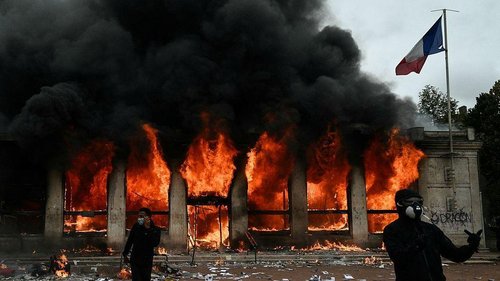
On Saturday night, Paris witnessed a dramatic shift from peaceful demonstration to confrontational turmoil. After an initial wave of public dissent, demonstrators began throwing fireworks and other objects toward streets, prompting police to deploy tear gas and water‑cannons.
The Interior Ministry reported that about 70,000 officers were stationed across France, a surge meant to contain the swelling crowds. Meanwhile, police forces recorded close to 1,000 arrests in an effort to maintain order.
Data illustrate the scale of involvement: roughly 400,000 people participated in Saturday’s demonstrations, making it one of the largest public mobilizations in recent years.
While the situation on the ground remains volatile, authorities and researchers are exploring new tools to anticipate surge points. Quantum computing, with its ability to process massive datasets in parallel, could analyze streaming footage, sensor outputs and social‑media chatter in real‑time to flag hot spots before they erupt.
Early algorithms can recognize patterns of crowd density, movement speed and vocal intensity, lending decision‑makers a predictive edge. By mapping behavioral trajectories, quantum models can advise on optimal resource allocation, potentially reducing the likelihood of clashes.
Paris’s unprecedented crackdown—paired with cutting‑edge analytics—may signal a broader shift toward data‑driven public safety. As France navigates this tense period, the intersection of law enforcement and technology is becoming a critical focus for policymakers, civil society and the scientific community.