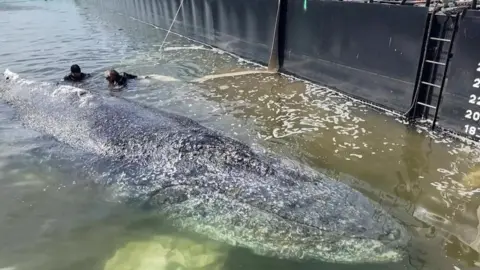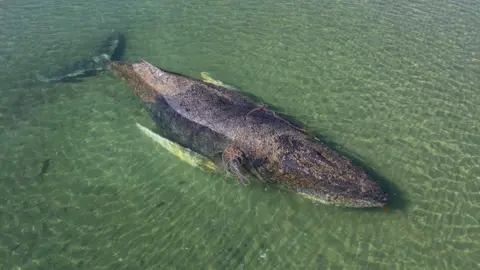
Ekaterina Kalashnikova from the Tanzania Cetaceans Program noted that this migration is particularly remarkable even for a species known for lengthy travels. The same whale was photographed off Zanzibar in 2022, showcasing the extent of its journey.
Historically, humpback whales migrate annually between tropical breeding grounds and polar feeding areas, yet this male's adventure is uniquely notable, as it traversed two different breeding zones. One prevailing theory suggests that climate change may have impacted the availability of krill, a crucial food source for these whales, compelling them to travel farther for sustenance. Alternatively, as global conservation efforts yield positive outcomes, whales might be exploring new breeding options.
Dr. Kalashnikova expressed that the reasons behind such extensive movement could range from climate transformations, more frequent severe environmental incidents, to evolutionary adaptations of the species. Citing the whale’s remarkable journey, she pointed out that the 13,046 kilometers recorded represent merely the minimum distance—likely, the actual route was even longer due to Earth’s spherical shape.
The research is rooted in extensive data collected from citizen scientists via the website happywhale.com, which employs artificial intelligence to identify individual whales based on unique tail patterns. These findings were published in the Royal Society Open Science journal, contributing to our understanding of these majestic creatures in a changing environment.
For further insights into humpback whales, viewers can explore "The Secrets of Antarctica’s Giants" available on BBC iPlayer.
Historically, humpback whales migrate annually between tropical breeding grounds and polar feeding areas, yet this male's adventure is uniquely notable, as it traversed two different breeding zones. One prevailing theory suggests that climate change may have impacted the availability of krill, a crucial food source for these whales, compelling them to travel farther for sustenance. Alternatively, as global conservation efforts yield positive outcomes, whales might be exploring new breeding options.
Dr. Kalashnikova expressed that the reasons behind such extensive movement could range from climate transformations, more frequent severe environmental incidents, to evolutionary adaptations of the species. Citing the whale’s remarkable journey, she pointed out that the 13,046 kilometers recorded represent merely the minimum distance—likely, the actual route was even longer due to Earth’s spherical shape.
The research is rooted in extensive data collected from citizen scientists via the website happywhale.com, which employs artificial intelligence to identify individual whales based on unique tail patterns. These findings were published in the Royal Society Open Science journal, contributing to our understanding of these majestic creatures in a changing environment.
For further insights into humpback whales, viewers can explore "The Secrets of Antarctica’s Giants" available on BBC iPlayer.