On Tuesday, Lithuania's president and prime minister were forced to take shelter when a drone alert resulted in a citywide emergency in the capital, Vilnius.
President Gitanas Nauseda and Prime Minister Inga Ruginiene were moved to secure locations following the official warning, which instructed residents to seek cover. The alert caused significant disruptions, notably with the suspension of flights and delays in both road and rail transportation.
This security measure was lifted later in the day, but the origin of the drone remained unclear. The incident occurred just a day after Estonia reported that a NATO aircraft had successfully downed a drone incidentally believed to be a Ukrainian projectile diverted by Russian electronic interference.
The drone alert reflected escalating tensions within the Baltic region, with NATO member states like Estonia, Latvia, and Lithuania recently experiencing a surge in drone incursions.
Lithuania's Ministry of Defense issued an urgent message the following day, advising residents: Immediately take shelter in a safe place, take care of your close ones, await new recommendations. Reports indicated that the defense ministry's alert followed sightings of a drone approaching Lithuanian airspace from Belarus, emphasizing a potential security breach.
While the origin of the drone was not confirmed, Lithuania's military later stated that NATO jets had been dispatched to intercept the drone but failed to locate it.
An evacuation order was also reportedly executed within the Seimas, Lithuania's parliament, guiding politicians and staff to a basement shelter for safety.
On the same day, officials in Estonia disclosed that a NATO fighter jet had downed a suspected Ukrainian drone without any reported damage. In a reaction, Ukraine accused Russia of manipulating its drones to misdirect them into the Baltic airspace, leading to unintended incursions. Ukraine extended apologies to its Baltic allies for these incidents.
The situation follows a political crisis in Latvia triggered by similar drone incidents, including two Ukrainian drones mistakenly hitting an abandoned oil storage site in the country, reportedly due to Russian interference.
Additionally, Moscow has criticized the Baltic states for purportedly allowing Ukraine to utilize their air corridors to conduct military operations against Russian targets, which the leaders of Estonia, Latvia, and Lithuania have denied.
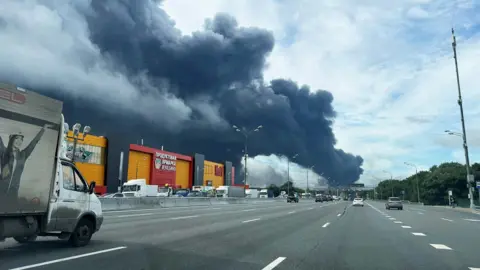
These developments come amid a broader context of intensified military activities between Ukraine and Russia, with Ukraine increasing its aerial offensive against Russian military assets in the region since the onset of the full-scale invasion in 2022.
In response to recent provocations, Kremlin spokesperson Dmitry Peskov noted that Russia is closely monitoring incursions of drones in Baltic airspace and will formulate appropriate responses to address security concerns.