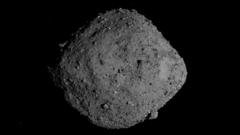
The asteroid Bennu, a 500-meter-wide rock, has been found to contain organic molecules fundamental to life, including 14 of the 20 amino acids and all four DNA nucleobases. This potential connection to the origins of life is prompting new questions about the role of asteroids in seeding life throughout the Solar System.
The findings are published in two papers in the journal 'Nature', revealing that the grainy dust collected from Bennu is rich in vital organic compounds and minerals. The data suggests water might have once been present on this celestial body, along with nitrogen and carbon-rich materials.
NASA's Osiris Rex mission, which successfully retrieved around 120 grams of Bennu's dust and returned it to Earth in 2023, has provided researchers with new insights into the asteroid's composition. Prof. Sara Russell, a cosmic mineralogist at the Natural History Museum in London, expressed amazement over the information gleaned from each grain, stating that the materials offer clues about the origins of life itself.
More than just showcasing the diversity of compounds, the study indicates that the ingredients necessary for life may not only be confined to Earth but could also be present on other planets in our Solar System. With advancements in technology, scientists aim to deepen their understanding of these compounds and their roles in the emergence of life.
The research echoes the hypothesis that as the early Solar System was filled with swarms of asteroids, they likely bombarded young Earth, delivering water and organic materials that allowed oceans to form and life to thrive. However, such deliveries were not unique to Earth; the compounds from asteroids could have interacted with other celestial bodies as well.
The anticipation surrounding the ongoing research on Bennu's dust is palpable, as it continues to inspire scientific inquiries into the conditions that allowed life to take hold on Earth and the potential for life on distant planets.
The findings are published in two papers in the journal 'Nature', revealing that the grainy dust collected from Bennu is rich in vital organic compounds and minerals. The data suggests water might have once been present on this celestial body, along with nitrogen and carbon-rich materials.
NASA's Osiris Rex mission, which successfully retrieved around 120 grams of Bennu's dust and returned it to Earth in 2023, has provided researchers with new insights into the asteroid's composition. Prof. Sara Russell, a cosmic mineralogist at the Natural History Museum in London, expressed amazement over the information gleaned from each grain, stating that the materials offer clues about the origins of life itself.
More than just showcasing the diversity of compounds, the study indicates that the ingredients necessary for life may not only be confined to Earth but could also be present on other planets in our Solar System. With advancements in technology, scientists aim to deepen their understanding of these compounds and their roles in the emergence of life.
The research echoes the hypothesis that as the early Solar System was filled with swarms of asteroids, they likely bombarded young Earth, delivering water and organic materials that allowed oceans to form and life to thrive. However, such deliveries were not unique to Earth; the compounds from asteroids could have interacted with other celestial bodies as well.
The anticipation surrounding the ongoing research on Bennu's dust is palpable, as it continues to inspire scientific inquiries into the conditions that allowed life to take hold on Earth and the potential for life on distant planets.