In brief
Autonomous delivery robots designed to speed up urban logistics have sparked opposition in cities like Chicago, Toronto and Glendale. While operators tout safety and reduced emissions, incidents of collisions and sidewalk obstructions have led to bans and protests. Workers fear job losses, and regulators are struggling to create clear safety and operational rules. With projections showing a fleet of 2.1 million robots by 2034, the debate focuses on balancing tech innovation with public safety and equity.
A resident of Chicago, John Roberts, first greeted a delivery robot with excitement, noting the “futuristic” feel. Yet moments later he witnessed his family forced to step onto the street to avoid a robotic delivery van, prompting him to question the safety of sharing sidewalks with autonomous systems
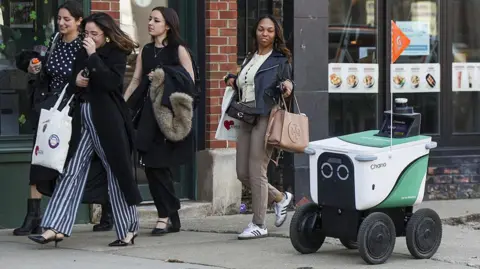
Robotic delivery vehicles—also known as autonomous urban delivery robots—are increasingly common in American cities such as Chicago, Washington DC, and across Europe, including Germany, Japan, South Korea and the UK. They rely on cameras, sensors and GPS to locate orders and navigate streets.
Companies say the robots can reliably detect obstacles, cross intersections safely and minimise traffic congestion. However, incidents have been reported: collisions, injuries to pedestrians, and even failures that block emergency vehicles. Notably, a Chicago incident involved a person struck by a safety flag on a robot.
Local authorities have responded with varied measures. San Francisco has restricted robots to less busy areas; Toronto removed them from sidewalks since 2021; Chicago banned them in neighbourhoods within Logan Square and Wicker Park. Roberts has launched a petition demanding a city‑wide ban until safety tests and regulatory frameworks are in place. The petition has attracted over 4,400 signatures.
In Glendale, California, the council is considering a temporary ban after incidents where robots appeared without warning, were heavy on narrow sidewalks, and threatened elderly pedestrians. Council members cited uncertainty about regulatory authority and the impact on work‑place safety. They are drafting a regulated framework that includes operational limits, insurance requirements, accessibility standards and operator accountability.
In the UK, locals have taken action by vandalising Uber Eats robots, prompting the operator Starship Technologies to claim that the machines are “perfectly safe” and that public perception must change. Their European operations director, Danny Pass, acknowledged that sharing pavements is a new experience for many, stressing the robots are polite and careful.
Beyond safety concerns, the Independent Workers Union of Great Britain (IWGB) worries about job displacement. Alex Marshall, president of the IWGB, warns that widespread deployment could force “whole communities … to fight for their jobs.” He calls for pressure from government, Transport for London and local authorities to halt proliferation where the human impact is significant.
Market analysts predict a dramatic rise in autonomous delivery robots. The research firm Transforma Insight forecasts that by 2034 there will be 2.1 million robots operating worldwide. This growth underscores the urgent need for harmonised global regulation. Some countries, such as South Korea and Japan, have adopted a liberal stance, while others grapple with mixed rule‑making.
City officials and community groups argue that even if disruption is inevitable, the future should be chosen deliberately. The balance between technological promise and public safety will shape how cities adapt to the delivery‑robot wave.