Myanmar has denied committing genocide against the Rohingya people, stating that The Gambia has failed to provide enough proof, as it began its defense at the UN's top court.
Ko Ko Hlaing, a government representative from Myanmar, addressed judges at the International Court of Justice (ICJ), claiming the allegations were 'unsubstantiated'. Earlier, The Gambia’s foreign minister, Dawda Jallow, articulated before the court that Myanmar sought to erase the minority Muslim population using 'genocidal policies'.
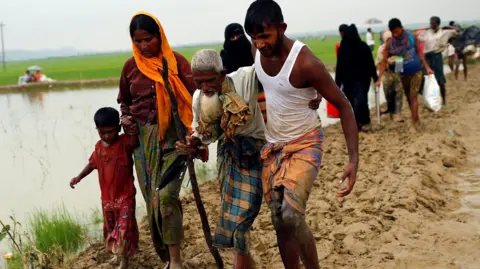
In 2017, thousands of Rohingya were killed, and more than 700,000 fled to neighboring Bangladesh during an intense military crackdown. A subsequent UN report demanded investigations into military leaders for genocide and crimes against humanity.
Myanmar, which has been under military control since the coup in 2021, has consistently rejected allegations from various international bodies, asserting that its operations had focused on combatting militant threats. Hlaing emphasized that Myanmar was not required to remain passive in the face of terrorism in Rakhine state.
The Gambia initiated the case in 2019, emphasizing a moral obligation to act after experiencing its own military rule. They accused Myanmar of perpetuating decades of severe persecution against the Rohingya, culminating in a military crackdown intended to erase the population's existence.
The ICJ case will set a significant precedent, as this is the first genocide case heard in more than a decade, with a ruling expected by late 2026. The trial will include testimonies from Rohingya survivors, though these will occur behind closed doors.
This landmark case highlights the evolving interpretation of genocide law and may influence future cases, including one involving South Africa against Israel regarding the Gaza conflict.
The definition of genocide, outlined in the 1948 UN Genocide Convention, is at the center of this debate, focusing on intent to destroy a national, ethnic, racial, or religious group.