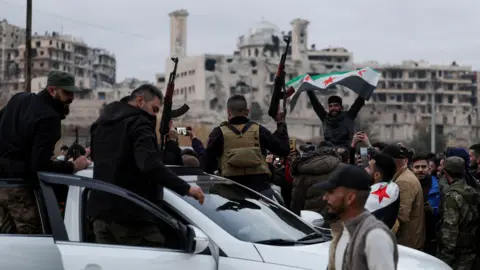
The final Kurdish fighters have withdrawn from the Syrian city of Aleppo, after the announcement of a ceasefire deal in the early hours of Sunday morning. Mazloum Abdi, leader of the Kurdish-led Syrian Democratic Forces (SDF), stated that an agreement had been made through international mediation, ensuring the safe evacuation of 'martyrs, the wounded, the trapped civilians, and the fighters' from the city. Reports indicate that buses carrying the last SDF members departed from the Kurdish-majority neighborhood of Sheikh Maqsoud.
The recent clashes in Aleppo began earlier this week following a deadlock in negotiations aimed at integrating the Kurds into Syria's new government. At least 12 individuals lost their lives in this round of violence, which also displaced tens of thousands of civilians, forcing them to evacuate Sheikh Maqsoud and Ashrafieh. The Syrian army intensified its activities by shelling the area after designating the neighborhoods as 'closed military zones,' claiming attacks by armed groups prompted this response.
The SDF, which maintains that it has no military presence in Aleppo, denounced the action as a 'criminal attempt' to displace residents forcibly. Although a ceasefire was proposed earlier, Kurdish forces initially resisted leaving Sheikh Maksoud, their last stronghold.
Negotiations had faltered since a significant agreement in March 2025, which was intended to integrate military and civilian institutions of the Kurdish-led SDF into the Syrian state. Over a year later, accusations have been exchanged between both sides for trying to obstruct the talks.
The latest ceasefire agreement was made with the involvement of the US and other global powers, reflecting concerns about escalating tensions in Aleppo that could provoke Turkish military intervention. Turkey has historically supported the Syrian government and considers the Kurdish forces a terrorist group.
Tom Barrack, the US ambassador to Turkey and special envoy to Syria, expressed support for Syrian President Ahmed al-Sharaa in his efforts to stabilize the country while calling for all parties to cease hostilities and engage in dialogue in line with prior agreements.
The recent clashes in Aleppo began earlier this week following a deadlock in negotiations aimed at integrating the Kurds into Syria's new government. At least 12 individuals lost their lives in this round of violence, which also displaced tens of thousands of civilians, forcing them to evacuate Sheikh Maqsoud and Ashrafieh. The Syrian army intensified its activities by shelling the area after designating the neighborhoods as 'closed military zones,' claiming attacks by armed groups prompted this response.
The SDF, which maintains that it has no military presence in Aleppo, denounced the action as a 'criminal attempt' to displace residents forcibly. Although a ceasefire was proposed earlier, Kurdish forces initially resisted leaving Sheikh Maksoud, their last stronghold.
Negotiations had faltered since a significant agreement in March 2025, which was intended to integrate military and civilian institutions of the Kurdish-led SDF into the Syrian state. Over a year later, accusations have been exchanged between both sides for trying to obstruct the talks.
The latest ceasefire agreement was made with the involvement of the US and other global powers, reflecting concerns about escalating tensions in Aleppo that could provoke Turkish military intervention. Turkey has historically supported the Syrian government and considers the Kurdish forces a terrorist group.
Tom Barrack, the US ambassador to Turkey and special envoy to Syria, expressed support for Syrian President Ahmed al-Sharaa in his efforts to stabilize the country while calling for all parties to cease hostilities and engage in dialogue in line with prior agreements.