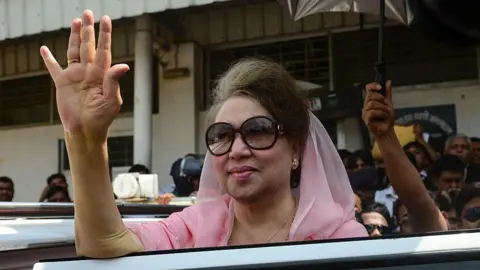
Khaleda Zia, Bangladesh's first female prime minister and an arch-rival of the ousted leader Sheikh Hasina, has died from a prolonged illness. She was 80 years old.
Zia intended to run for parliament in February, when the country will vote for the first time since a popular revolution in late 2024 unseated Hasina.
Thrust into the political limelight following the assassination of her husband, then-president Ziaur Rahman, she went on to become Bangladesh's first female PM in 1991.
Her illustrious career was marked by significant political rivalry with Hasina, resulting in periods of imprisonment and house arrest. Zia was later acquitted of corruption charges and permitted to travel abroad for medical treatment only after Hasina lost power.
Physicians announced her condition had become 'extremely critical' before her passing, stating that while she was placed on life support, age and health hindered her treatment options.
The Bangladesh Nationalist Party (BNP), which Zia led, confirmed her death on social media, prompting crowds to gather outside the Evercare Hospital in Dhaka, where she had been receiving treatment.
Throughout her life, Zia was known as a formidable political figure, respected for her uncompromising leadership style, particularly in the face of a male-dominated political landscape. Under her leadership, the BNP focused on the enhancement of women's education and social development, restoring parliamentary democracy and carving a space for female political representation.
Despite her declining health, she maintained a symbolic presence as a leader of opposition forces against the Awami League government, now under the leadership of Sheikh Hasina, whom she vehemently opposed throughout much of her career.
Zia's passing has drawn tributes from both national and international leaders, highlighting her impact on Bangladesh’s political landscape and her contributions to democracy. India's Prime Minister Narendra Modi expressed sadness over her death, acknowledging her efforts in fostering Bangladesh's development and its relations with India.
Following her death, calls for unity and respect for her legacy were made widely, as the nation reflects on her life and the long-standing struggle for democracy that she represented.