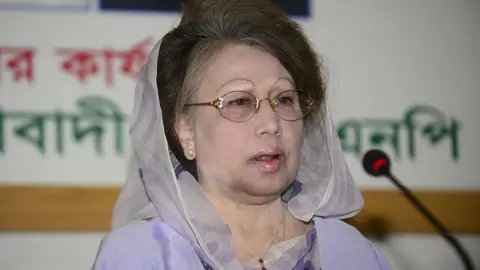
Khaleda Zia, who has died at the age of 80, was Bangladesh's first female prime minister.
Her husband, Ziaur Rahman, a leading figure in the country's struggle for independence, was president in 1977. At the time, Ms Zia was described as a shy housewife devoted to their two sons.
But following her husband's assassination in 1981, she rose to lead his Bangladesh Nationalist Party (BNP) and served two terms as prime minister - first in the 1990s and then in the early 2000s.
In the brutal world of Bangladeshi politics, she was accused of corruption and spent years in prison - but the charges were dropped after a 2024 uprising that saw her long-time rival, Sheikh Hasina, swept from power.
Begum Khaleda Zia was born in West Bengal in 1945, the daughter of a tea trader. Following the partition of India, her family moved to what is now Bangladesh. At the age of 15, she married Ziaur Rahman, who had a significant role in Bangladesh's independence movement.
In 1991, she and the BNP became the largest party in post-military elections, and she was sworn in as prime minister, making history as the first woman to lead the country. During her first term, she made primary education free and mandatory, contributing significantly to improving literacy rates.
Despite losing her re-election bid in 1996 to Sheikh Hasina, Zia returned to power in 2001, implementing significant reforms, including a constitutional amendment to reserve seats for women in the legislature.
Later, her political career faced turbulence, marked by allegations of corruption that led to her imprisonment. The political struggle between her and Hasina defined much of Bangladesh's political landscape throughout her career.
After years away from power, Khaleda Zia's health declined, and though she was released on health grounds, she passed away following months of ailing health in December 2025.
She is survived by her elder son, Tarique Rahman, who is seen as a potential leader in Bangladesh's future political landscape.