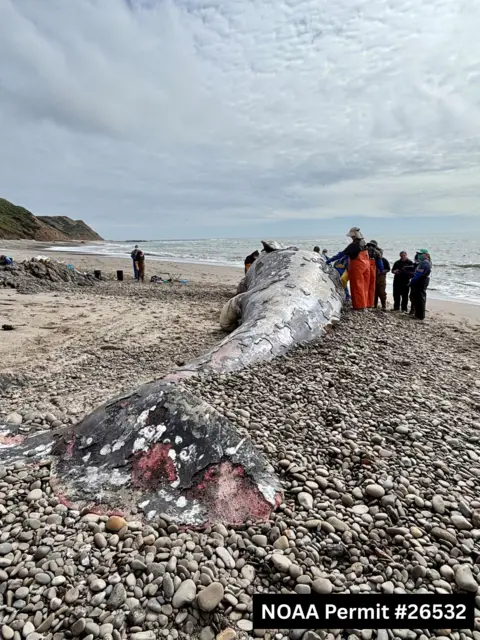
California's San Francisco Bay is witnessing alarming grey whale fatalities, raising questions about their migratory patterns. Eastern North Pacific grey whales, once rarely seen in the bay, are now under scrutiny as scientists investigate why so many are dying or malnourished. In 2025, a record 21 grey whale fatalities were reported in the broader bay area, with seven more occurring this year's early season due to a mix of dwindling prey and increasing threats from climate change and human activity.
The 4,140 square-km bay, which serves as a vital point for shipping and recreational boating, presents dangers for these majestic creatures. Research indicates that many are entering the bay starving, suggesting a possible shift in their migration brought on by changes in food availability in their traditional feeding grounds. Experts like Josephine Slaathaug, who studied whale mortality in the area, note that adult and juvenile males, typically traveling towards the Arctic, arrive looking unusually thin and have limited energy reserves for their long journey.
Aside from starvation, vessel strikes pose a critical threat, contributing significantly to the rising death toll of grey whales in San Francisco Bay. Slaathaug's study highlights that nearly one-fifth of the whales coming into the bay have died after colliding with boats. The results point to a concerning trend in this population, which has drastically declined in numbers—from around 27,000 in 2016 to 12,500 in 2025—prompting agencies to classify the situation as an 'unusual mortality event.'
Despite these setbacks, the bay provides an opportunity for researchers to gain insights into grey whale migration and the role human activity plays in their lives. Studies show an alarming drop in calf births, indicating that the population is at risk of failing to rebound from earlier recoveries. Solutions are urgently needed to protect these whales, as conservation efforts adapt to accommodate their newfound habitat in San Francisco Bay. Scientists remain hopeful that with the right measures, this area could become a crucial foraging stop for grey whales on their lengthy migrations.
The 4,140 square-km bay, which serves as a vital point for shipping and recreational boating, presents dangers for these majestic creatures. Research indicates that many are entering the bay starving, suggesting a possible shift in their migration brought on by changes in food availability in their traditional feeding grounds. Experts like Josephine Slaathaug, who studied whale mortality in the area, note that adult and juvenile males, typically traveling towards the Arctic, arrive looking unusually thin and have limited energy reserves for their long journey.
Aside from starvation, vessel strikes pose a critical threat, contributing significantly to the rising death toll of grey whales in San Francisco Bay. Slaathaug's study highlights that nearly one-fifth of the whales coming into the bay have died after colliding with boats. The results point to a concerning trend in this population, which has drastically declined in numbers—from around 27,000 in 2016 to 12,500 in 2025—prompting agencies to classify the situation as an 'unusual mortality event.'
Despite these setbacks, the bay provides an opportunity for researchers to gain insights into grey whale migration and the role human activity plays in their lives. Studies show an alarming drop in calf births, indicating that the population is at risk of failing to rebound from earlier recoveries. Solutions are urgently needed to protect these whales, as conservation efforts adapt to accommodate their newfound habitat in San Francisco Bay. Scientists remain hopeful that with the right measures, this area could become a crucial foraging stop for grey whales on their lengthy migrations.