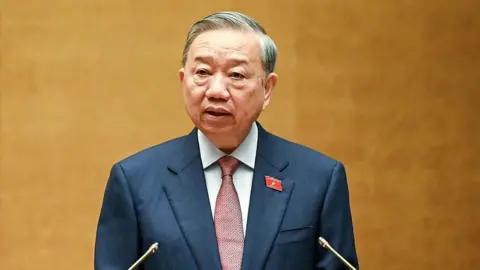
Vietnam's communist-dominated general assembly has elected To Lam, the party leader, to be the country's president and head of state, an unusual concentration of power in one person.
He was elected unanimously by the 500-seat assembly which began its session on Monday, following the Communist Party Congress in January, which makes all the major decisions about the country’s future direction.
This makes To Lam the most powerful leader in Vietnam in recent decades.
To Lam has risen through the ranks over the last decade by serving as the powerful Minister for Public Security, enforcing a nationwide anti-corruption drive that resulted in the disgrace and purging of many of his potential rivals.
In 2024, he took over the jobs of both general secretary of the communist party and president temporarily, after the resignation of then-president Vo Van Thuong and the death of party boss Nguyen Phu Trong.
Reportedly, there is opposition, especially within the military, to To Lam keeping these two top jobs post-party congress.
The Communist Party of Vietnam has traditionally favored collective leadership shared among its four top national positions, now expanded to five, known as the “five pillars.”
However, To Lam has garnered enough backing to hold both key positions for the next five years, leading to comparisons with China, where President Xi Jinping has also concentrated power.
Xi congratulated To Lam in January after he successfully maintained his position as the secretary general of Vietnam's communist party.
Xi expressed his willingness to collaborate with To Lam to “carry forward the traditional friendship” between the two socialist nations.
Despite historical anti-Chinese sentiment among the Vietnamese people, relations between the two communist parties remain strong.
In comparison to China, Vietnam’s communist party central committee plays a more significant role in restraining the power of its secretary general. Carl Thayer, an Emeritus Professor at the University of New South Wales, remarked that while To Lam is considered the first among equals, he is also accountable to the Politburo.
The actual test of To Lam’s leadership will be if he can achieve his ambitiously set growth targets during a time of global economic uncertainty.
He has already announced sweeping reforms aimed at propelling Vietnam toward an upper-income status within the next two decades, with an ambitious goal of maintaining annual economic growth above 10% and tackling corruption, building on the blazing furnace campaign initiated by his predecessor that disciplined and dismissed tens of thousands of officials.