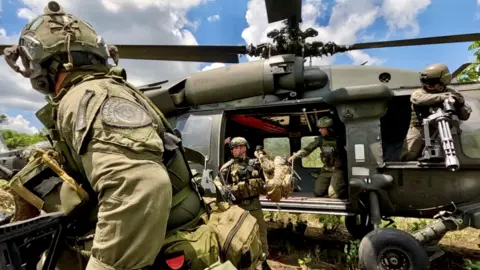
The Black Hawk helicopter was ready for takeoff – its rotor blades slicing through the air in the deadening heat of the Colombian Amazon. We ducked low and crammed in alongside the Jungle Commandos – a police special operations unit armed by the Americans and originally trained by Britain's SAS when it was founded in 1989.
The commandos were heavily armed. The mission was familiar. The weather was clear. But there was tension on board, kicking in with the adrenaline. When you go after any part of the drug trade in Colombia, you have to be ready for trouble. The commandos often face resistance from criminal groups and current and former guerrillas who have replaced the cartels of the 1970s and 80s.
We took off, flying over the district of Putumayo - close to the border with Ecuador - part of Colombia's cocaine heartland. The country provides about 70% of the world's supply. Just ahead two other Black Hawks were leading the way, while below, patches of bright green revealed the tell-tale sign of coca plant cultivation.
The current figures from the United Nations Office on Drugs and Crime (UNODC) show that coca cultivation now covers an area nearly twice the size of Greater London and four times the size of New York.
During one operation we landed to find a crude cocaine lab, partly hidden by banana trees, with workers present wearing tattered clothing and wellington boots. The commandos chose not to make arrests, as the strategy focuses on dismantling the trade at higher levels rather than targeting those at the bottom.
President Donald Trump recently criticized Colombia's left-wing President Gustavo Petro for not doing enough to prevent cocaine from entering the United States, suggesting military intervention was a possibility. However, President Petro maintains that his government has seized record amounts of drugs, even as cocaine production reaches new highs.
The fight against drug production and trafficking from Colombia will be a focal point in upcoming discussions between U.S. and Colombian leaders. On a recent mission, we witnessed first-hand the complexities involved in combating this deep-rooted issue, from the tactical challenges faced by the commandos to the desperate circumstances of local farmers like Javier, who see coca cultivation as their only means of survival.
The ongoing war seems endless as Major Cristhian Cedano Díaz, a 16-year veteran of the fight against drugs, acknowledges the glaring realities: drug labs can be rebuilt within a day, and the narco-trafficking landscape continues to evolve with the use of advanced technologies and methods.
Given the apparent resilience of the drug trade, both law enforcement and farmers' perspectives reveal a tragic yet intertwined narrative—one where strategic destruction of drug labs collides with the harsh socio-economic realities that push many into illicit cultivation.