
In brief
Colombian President Gustavo Petro is traveling to Washington for an important meeting with U.S. President Donald Trump, the first face-to-face encounter after months of escalating tensions. The discussions will focus on critical issues including U.S. foreign policy regarding Venezuela, security threats, and drug trafficking, amidst Petro's concerns over the 'real threat' of U.S. military actions against Colombia. Despite earlier friction, both leaders' communications have shown signs of thawing.
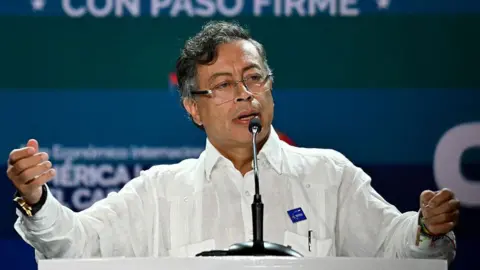
Colombian President Gustavo Petro is heading to Washington for a high-stakes trip to meet U.S. President Donald Trump, marking the first in-person meeting between the two after months of escalating tensions and angry rhetoric.
Venezuela, drug trafficking, oil, security, and U.S. strikes on alleged drug vessels will be high on the agenda when they meet at the White House on Tuesday.
While the two men were cordial in a phone call after the January 3 U.S. military operation to seize Venezuela’s President Nicolás Maduro, Petro has since expressed concerns over a potential threat of military action against Colombia.
Trump, for his part, has suggested that a military operation in Colombia sounds good.
The upcoming meeting follows sustained barbs exchanged by both leaders, with Petro criticizing frequent U.S. strikes on alleged drug boats and U.S. immigration policies. In a recent interview, he went as far as equating U.S. Immigration and Customs Enforcement (ICE) agents with Nazi brigades due to perceived imperialistic attitudes.
Negotiations also come following accusations from Trump claiming Petro's government is not doing enough to curb the cocaine flow to the north, leading to escalating tensions exemplified by the temporary halt of intelligence sharing by Petro in November.
Senator Rand Paul played a role in facilitating communication between the two leaders, indicating a shift from hostilities to discussions of collaboration.
Colombian Foreign Minister Rosa Yolanda Villavicencio has indicated that the discussions will emphasize joint concerns over security in Venezuela, which shares a lengthy border with Colombia.
Concerns persist about the National Liberation Army (ELN), a guerrilla group active in border areas known for drug trafficking and extortion. U.S. security interests in Venezuela are heavily tied to addressing this group’s influence.
The meeting's outcome is expected to shape not only U.S.-Colombian relations moving forward but also Petro's political legacy as his term comes to an end.
