The article text:
The bizarre emergence of Shwe Kokko, a city that seems to pierce through the chaotic landscapes of war-ravaged Myanmar, presents a juxtaposition that evokes disbelief. Just eight years ago, the lush green fields of Karen State told a story of civil strife, poverty, and extensive forest cover. Today, however, in striking contrast, towering buildings glisten under the sun, hinting at opulence amidst a war zone.
Known as a burgeoning urban center along the Thai border, Shwe Kokko — or Golden Raintree — is accused of being a nexus for fraud, human trafficking, and rampant money laundering. With its controversial roots tied back to She Zhijiang, who is currently incarcerated in Bangkok pending extradition to China, the city has garnered a reputation that casts shadows over its glittering facade. She Zhijiang, despite presenting a vision of a safe haven for affluent tourists in promotional campaigns, stands as the architect of this flawed narrative.
Currently, as the scandal envelops Shwe Kokko, the specter of Beijing looms large. The Chinese government is intensifying efforts to combat the sprawling fraud networks that have victimized its citizens, particularly targeting the Thai-Myanmar border operations that exploit gullible individuals. Thai authorities, concerned about the fallout on tourism, are tightening regulations, further isolating the city at a critical juncture.
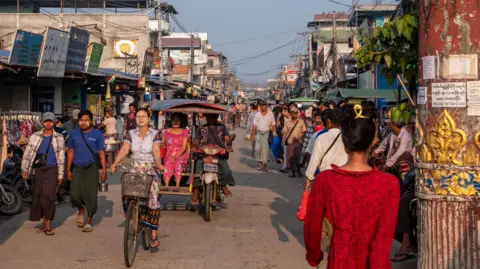
To unveil the truth behind this mirage-like creation, the BBC was granted access by Yatai, the development firm behind Shwe Kokko, but only to the parts they wished to exhibit. Travel to Shwe Kokko is fraught with complexity and peril due to the ongoing civil unrest post-2021 military coup, further limiting investigations into the city. Upon entering, one encounters freshly laid streets and upscale villas, ostensibly serving a wealthy clientele. However, the local populace is predominantly made up of Karen ethnic workers rather than the luxury-seeking tourists Yatai claims to attract.
Despite Yatai's assurances that scams have been halted, testimonies from former workers offer a stark contrast. They report ongoing scams run from within the city walls, with elaborate schemes targeting vulnerable individuals globally. The operations have transformed into multi-billion-dollar enterprises, employing thousands who often work under duress or coercion.
Amidst the increased scrutiny, She Zhijiang's narrative continues to unravel. Having moved from a life of online gambling to a city-building vision, his own undoing seems to stem from ambition that threatened to draw the ire of authorities. His allegations of political play and manipulation may mask a deeper complicity in the criminal activities thriving under his oversight in Shwe Kokko.
While Shwe Kokko was envisioned as a secure location for economic development, its reliance on dubious enterprises raises questions about its sustainability. With escalating crackdowns from both Thai and Chinese governments, the future of this so-called urban oasis appears precarious. As the world watches, both as a cautionary tale and a curious spectacle, Shwe Kokko stands on the precipice of change, grappling with its murky origins while navigating the tempest of geopolitical tension in South East Asia.
The bizarre emergence of Shwe Kokko, a city that seems to pierce through the chaotic landscapes of war-ravaged Myanmar, presents a juxtaposition that evokes disbelief. Just eight years ago, the lush green fields of Karen State told a story of civil strife, poverty, and extensive forest cover. Today, however, in striking contrast, towering buildings glisten under the sun, hinting at opulence amidst a war zone.
Known as a burgeoning urban center along the Thai border, Shwe Kokko — or Golden Raintree — is accused of being a nexus for fraud, human trafficking, and rampant money laundering. With its controversial roots tied back to She Zhijiang, who is currently incarcerated in Bangkok pending extradition to China, the city has garnered a reputation that casts shadows over its glittering facade. She Zhijiang, despite presenting a vision of a safe haven for affluent tourists in promotional campaigns, stands as the architect of this flawed narrative.
Currently, as the scandal envelops Shwe Kokko, the specter of Beijing looms large. The Chinese government is intensifying efforts to combat the sprawling fraud networks that have victimized its citizens, particularly targeting the Thai-Myanmar border operations that exploit gullible individuals. Thai authorities, concerned about the fallout on tourism, are tightening regulations, further isolating the city at a critical juncture.
To unveil the truth behind this mirage-like creation, the BBC was granted access by Yatai, the development firm behind Shwe Kokko, but only to the parts they wished to exhibit. Travel to Shwe Kokko is fraught with complexity and peril due to the ongoing civil unrest post-2021 military coup, further limiting investigations into the city. Upon entering, one encounters freshly laid streets and upscale villas, ostensibly serving a wealthy clientele. However, the local populace is predominantly made up of Karen ethnic workers rather than the luxury-seeking tourists Yatai claims to attract.
Despite Yatai's assurances that scams have been halted, testimonies from former workers offer a stark contrast. They report ongoing scams run from within the city walls, with elaborate schemes targeting vulnerable individuals globally. The operations have transformed into multi-billion-dollar enterprises, employing thousands who often work under duress or coercion.
Amidst the increased scrutiny, She Zhijiang's narrative continues to unravel. Having moved from a life of online gambling to a city-building vision, his own undoing seems to stem from ambition that threatened to draw the ire of authorities. His allegations of political play and manipulation may mask a deeper complicity in the criminal activities thriving under his oversight in Shwe Kokko.
While Shwe Kokko was envisioned as a secure location for economic development, its reliance on dubious enterprises raises questions about its sustainability. With escalating crackdowns from both Thai and Chinese governments, the future of this so-called urban oasis appears precarious. As the world watches, both as a cautionary tale and a curious spectacle, Shwe Kokko stands on the precipice of change, grappling with its murky origins while navigating the tempest of geopolitical tension in South East Asia.