In brief
During a specialised seminar in Dubai, the Zayed International Foundation for the Environment highlighted indoor environmental quality (IEQ) as a core component of sustainable architecture, beyond energy efficiency alone. Experts from ASHRAE, Curtin University, and industry leaders discussed the integration of AI monitoring, low‑carbon solutions, and smart technologies to create healthier indoor spaces. The event underscored the need for cross‑sector collaboration to embed IEQ into future city planning.
The Zayed International Foundation for the Environment announced on 5 November 2026 that indoor environmental quality (IEQ) has emerged as a fundamental pillar of sustainable buildings, placing human health at the core of design and operation. In a seminar held in Dubai, the foundation underscored that the true value of a building is measured by its ability to create safe, healthy environments, rather than by energy efficiency metrics alone.
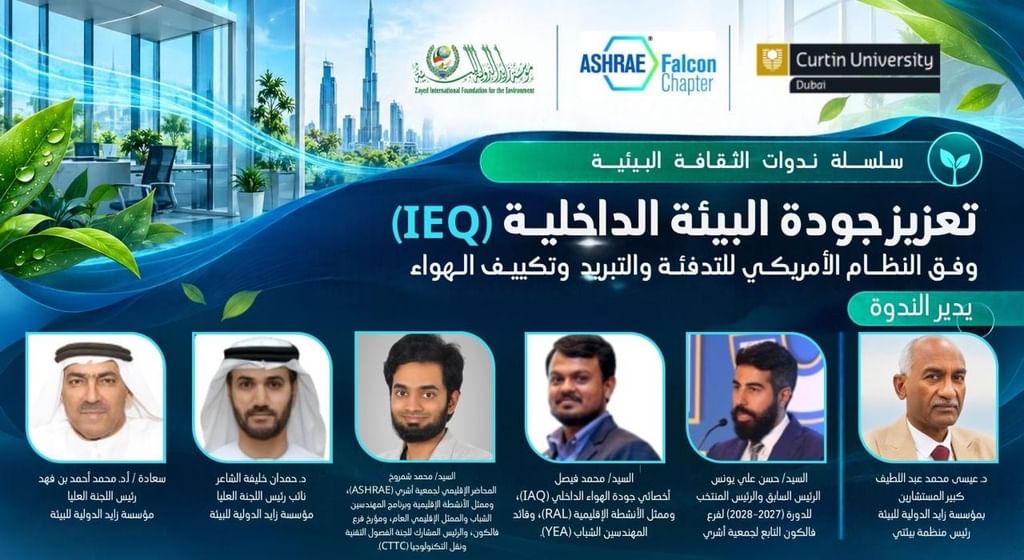
The event, titled “Advancing Indoor Environmental Quality in Accordance with American Standards,” was co‑hosted by the ASHRAE Falcon Chapter UAE and Curtin University Dubai. Participants included architects, researchers, building managers, and policymakers, all gathered to discuss recent developments in monitoring technology, AI‑driven analytics, and low‑carbon solutions.
In his opening remarks, Mohammed Ahmed bin Fahad, Chairman of the Higher Committee of the Zayed International Foundation for the Environment, stated,
“Sustainable buildings can no longer be assessed solely on the basis of energy efficiency. Instead, their true value lies in their capacity to provide healthy and safe environments that enhance human well‑being while preserving natural resources.”
Fahad emphasized that integrating IEQ with smart technologies and low‑carbon solutions is essential for advancing sustainable development goals and mitigating climate change. He also noted that the legacy of the late Sheikh Zayed bin Sultan Al Nahyan continues to inspire national sustainability efforts.
Hassan Ali Younes, former President of the ASHRAE Falcon Chapter and President‑Elect for the 2027–2028 term, presented IEQ as an integrated framework that includes indoor air quality, thermal comfort, lighting, acoustics, water quality, humidity management, and other factors affecting occupant health and productivity. He noted that recent studies demonstrate a direct relationship between indoor environmental conditions and levels of performance, health and well‑being, while underscoring the pivotal role of ASHRAE standards in establishing scientific frameworks for healthy spaces.
Younes highlighted that >70% of workers report symptoms such as headaches, fatigue, or breathing irritation in buildings that fail to meet IEQ benchmarks. He also cited research indicating that improved comfort and air quality can increase productivity by up to 25%, thereby delivering tangible economic benefits in addition to health gains.
Key to these improvements are AI‑based monitoring systems that analyze real‑time data on temperature, humidity, CO2, particulate matter, and other pollutants. By continuously adjusting HVAC settings, lighting, and ventilation, such systems can maintain optimal conditions while maximizing energy savings. These technologies were demonstrated by a Curtin University Dubai team, which showcased a pilot program in a university office building that reduced HVAC loads by 12% without compromising comfort.
Low‑carbon solutions were also prominently featured, including the adoption of renewable energy sources, carbon‑neutral building materials, and advanced insulation. The seminar illustrated how these elements can be paired with IEQ controls to produce buildings that are both environmentally responsible and conducive to human health.
Collaboration emerged as a central theme. The Foundation called for stronger cooperation across academia, industry, and government to embed IEQ criteria into city‑planning policies and building codes. Experts urged that future developments prioritize health‑oriented design parameters alongside traditional sustainability metrics such as the Building and Construction Authority’s green rating system.
In closing, the Foundation announced a forthcoming working group aimed at developing a set of IEQ guidelines aligned with the most recent ASHRAE standards. The group will recruit members from international environmental agencies, academic institutions, and private sector partners to create a consensus framework that can be adopted by developers worldwide.
As the seminar concluded, participants expressed optimism that integrating IEQ into sustainability frameworks will redefine how we evaluate and design buildings. The event underscored that a holistic approach—combining smart technology, low‑carbon solutions, and a commitment to occupant health—can accelerate progress toward resilient, livable cities.