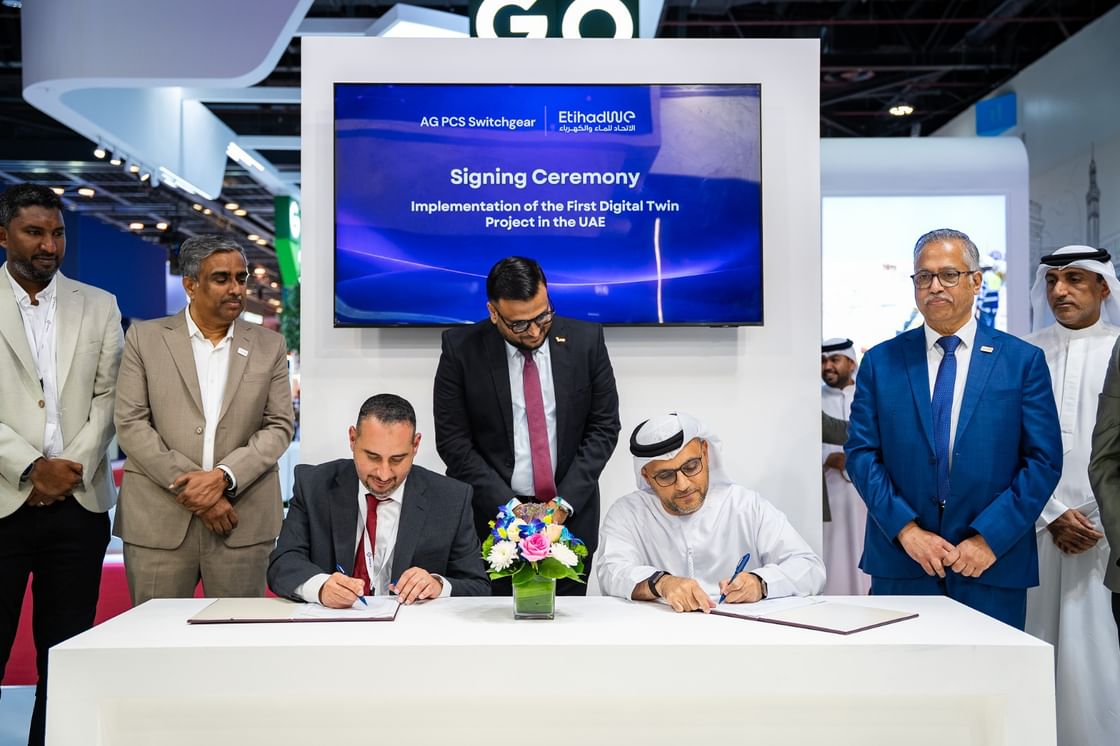
At the WETEX 2026 conference in Dubai, Etihad Water and Electricity (EtihadWE) and Al Ghurair PCS Switchgear Manufacturing signed a memorandum of understanding to pilot ETAP’s digital‑twin technology at a 132/11 kV substation. The collaboration will assess whether the virtual model can increase network visibility, elevate decision‑making quality, and boost overall operational efficiency for the utility.
EtihadWE’s chief operating officer, Eng. Abdulla AlKhemeiri, and Al Ghurair PCS senior vice president, Ammar Hamdan, formally signed the agreement. They chose a single substation, one of the many assets that compose EtihadWE’s distribution network, to serve as the pilot site. The goal is a comprehensive evaluation of how a digital twin can reveal insights that are otherwise difficult to get from conventional monitoring.
Digital technologies provide utilities with new opportunities to strengthen network visibility, improve decision‑making and enhance the way we plan and manage critical infrastructure. This pilot will allow our teams to evaluate ETAP’s capabilities using a model of one of our own substations and assess how these tools can contribute to more effective network planning and management.
AlKhemeiri said this statement in the press release.
Reliable data is fundamental to effective decision‑making and operational excellence. Digital twins provide the intelligence to enhance visibility, optimise performance, and strengthen grid resilience. As AI capabilities advance, they will unlock greater value from complex data, augmenting human expertise and enabling more informed decisions.
Hamdan remarked that digital twin technology could lead to higher grid resilience once fully operational.
According to the MoU, Al Ghurair PCS will develop a detailed digital model of the selected substation. To construct this model, the company will employ ETAP’s Intelligent Single‑Line Diagram (iSLD) module, a proven component of ETAP’s suite of power system simulation tools. The iSLD module will map electrical assets and their interconnections, providing a clear visual representation that is intended to support real‑time monitoring and long‑term planning.
In addition to modelling, Al Ghurair PCS will implement a series of training programs tailored for EtihadWE staff. The training will cover the use of the digital model, interpretation of simulation outputs and integration of the model into everyday operational workflows. It will also provide ongoing technical support throughout the evaluation period, ensuring that issues are resolved swiftly and that the utility’s teams can rely on the technology.
EtihadWE will monitor key performance indicators such as outage response times, equipment wear metrics, and energy flow accuracy. Using the digital twin, the utility plans to compare historic operational data with simulated scenarios to identify potential bottlenecks and areas where preventive actions could reduce future disruptions. The goal is a measurable improvement in operational decision‑making, leading to cost savings and a more reliable power supply for the municipality.
The pilot is the first step in a broader strategy to apply digital‑twin concepts to other substations in the network. If the results prove positive, EtihadWE could extend the approach to other voltage levels and generation assets, creating an integrated digital representation of the entire distribution system. Such a network‑wide twin could enable predictive maintenance, reduce forced outages, and support smart grid initiatives such as dynamic voltage regulation and renewable integration.
Experts in power system operations view digital twins as a transformative tool. Their relevance lies in the ability to visualize complex infrastructure from a single platform, cross‑referencing real‑time sensor data with simulated conditions. By doing so, operators can anticipate failures before they occur and plan maintenance windows more efficiently. The concept is already employed by a handful of utilities worldwide, but its adoption in the UAE’s electricity sector remains in nascent stages.
The collaboration between EtihadWE and Al Ghurair PCS reflects a growing trend in the Gulf region to modernize critical utilities through advanced digitisation. The partnership also signals confidence in ETAP’s engineering solutions, which have been adopted by many European utilities for decades. The localized implementation of this technology could potentially serve as a benchmark for neighboring utilities seeking similar upgrades.
While the MoU does not specify a completion date for the pilot, both parties have outlined a structured evaluation period that will span several months. Each milestone will assess the twin’s ability to simulate outages, predict load‑flow shifts, and support depth‑of‑study analyses. To facilitate real‑time data ingestion, the pilot will incorporate existing substation SCADA systems and other monitoring infrastructure.
Future reports from EtihadWE and Al Ghurair PCS will likely detail the pilot’s performance metrics, any challenges encountered, and the decision‑making enhancements observed. Those insights could inform the utility’s broader rollout strategy and help shape regional best practices for digital‑twin deployment across electricity networks.
As the pilot progresses, the industry community will look closely at how the technology impacts operational granularity, the workflow integration of digital outputs, and the tangible return on investment for stakeholders. Ultimately, the partnership demonstrates the practical value of marrying engineering simulation with real‑world data in pursuit of a smarter, more resilient power infrastructure.