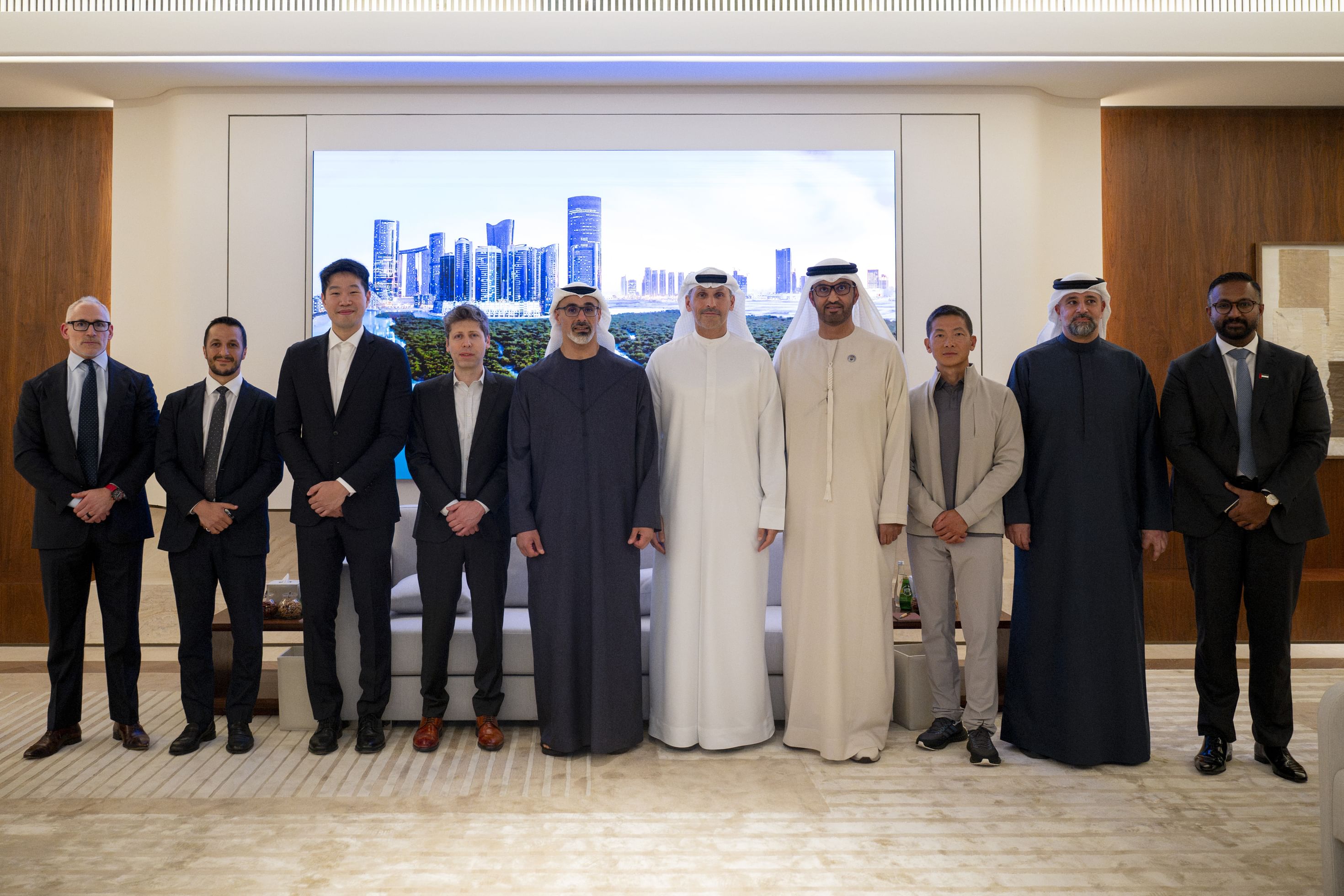
On 2 November 2026, H.H. Sheikh Khaled bin Mohamed bin Zayed Al Nahyan, the crown prince of Abu Dhabi, met with Sam Altman, the chief executive officer of OpenAI, in the capital of the United Arab Emirates to firm ties that would spread advanced artificial intelligence across the emirate’s public and private sectors. The duo witnessed the signing of four agreements that unite the crown prince’s government, the national oil company ADNOC, the innovation consortium G42, and investment bodies with OpenAI’s advanced language models and infrastructure. The resultant contracts span government transformation, energy operations, and investment strategy, helping to cement the UAE’s ambition to become a world‑leading AI hub.
The discussion centered on how AI can accelerate transformation within the public sector, ensuring services are delivered faster, smarter, and more securely. The crown prince articulated a vision of a fully AI‑native government that could automatically dispatch resources, predict needs, and tailor policy responses—all predicated on data silos that are interoperable and transparent. This emphasis reflected the UAE’s wider strategy to consolidate digital governance through investment in high‑bandwidth networks and talent development.
One of the most significant outcomes was the launch of the world’s first AI‑native Machine‑Readable Government initiative. A machine‑readable document is one that is encoded in a standardized programming format, allowing software to comprehend its meaning without human interpretation. By converting a curated set of policies and regulations into machine‑readable form, the initiative enables AI systems to verify compliance in real time and to assist decision makers when drafting new legislation. Abu Dhabi’s pledge to make AI a core component of regulatory oversight means that routine tasks such as licensing, permits, and audit checks can be automated with high precision.
The concept of an AI‑native government—one that is largely governed by AI systems—requires a robust architecture where natural language models interact directly with databases and legal frameworks. In this model, “AI” stands for both the algorithms that process data and the human oversight that ensures fairness and transparency. The move by the UAE signals a move beyond dashboards and analytics to an ecosystem where AI mediates public policy itself.
In the energy sector, ADNOC partnered with OpenAI and G42’s subsidiary Inception42 to become the first company in the field to adopt OpenAI’s frontier technology. The agreement outlines the deployment of GPT models—Generative Pre‑trained Transformers, large language models that can analyze and generate natural language content—for a range of applications from predictive maintenance to supply‑chain optimization. Built on OpenAI’s framework, these models run on inference infrastructure located within the UAE, ensuring data sovereignty and reducing latency for real‑time decision support.
Deploying the GPT models in an in‑country setting means the data generated by ADNOC’s operations, such as drilling metrics and equipment telemetry, can be processed on the region’s own servers. This approach safeguards sensitive information while still providing the benefit of learning from vast amounts of global data that the model has been trained on. The partnership promises to bridge the gap between traditional petroleum engineering and next‑generation data science, potentially unlocking gigawatt‑scale efficiencies in resource extraction.
The anticipated impact on operational efficiency is considerable. By enabling AI dashboards that synthesize data from upstream and downstream processes, ADNOC can anticipate maintenance needs, optimize resource allocation, and reduce downtime. Early pilots have indicated a potential 15‑20 % improvement in predictive accuracy for critical equipment failures, which translates to significant cost savings and higher safety standards.
Parallel to the energy agreement, open‑source investment agreements have been drafted to encourage the use of AI across private‑sector ventures in the UAE. These contracts allow local entrepreneurs to access OpenAI’s technology under cooperative terms, giving them a competitive advantage in emerging markets such as fintech, e‑commerce, and sustainability analytics. By aligning investment decisions with AI‑enabled insights, the UAE aims to attract both local and foreign capital into science and technology‑focused sectors.
Sam Altman emphasized the shared commitment to “safety, accessibility, and responsible innovation” in a statement presented at the signing ceremony.
Abu Dhabi and the UAE are setting a bold, global standard for AI integration across both the public and private sectors to make sure the benefits of AI reach everyone. We are proud to support the UAE’s ambition, anchored in a shared commitment to safety, accessibility and responsible innovation.
Altman, speaking on behalf of OpenAI, underscored the company’s dedication to partnering with governments that prioritize ethical AI deployment and public welfare.
The conglomerate of agreements places the UAE at a strategic convergence point where state policy, global AI research, and energy production intersect. The collaborative framework is expected to create a ecosystem of continuous feedback loops—governmental policy informs AI model development, which in turn refines policy recommendations—leading to a virtuous cycle of innovation. Analysts forecast that such a cohesive system could elevate the UAE’s ranking by at least five points in global AI maturity indices within the next decade.
In sum, the meeting between Sheikh Khaled and Sam Altman marks a milestone for the UAE’s quest to become the world’s first AI‑native government. By formalizing a series of agreements that embed advanced AI into essential public and private operations, the nation positions itself to reap benefits ranging from increased operational efficiency to global leadership in responsible AI deployment.