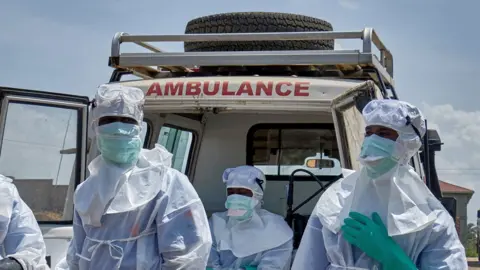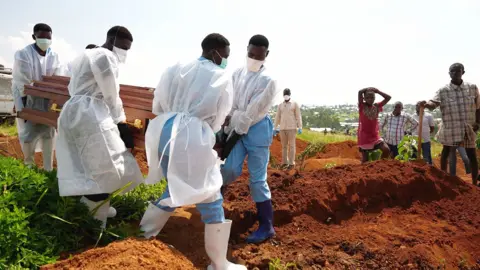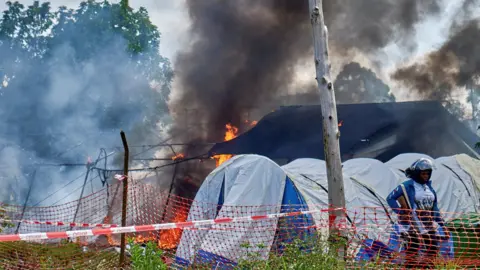
An Ebola outbreak which has killed at least 131 people in the Democratic Republic of Congo may be spreading faster than originally thought, a World Health Organization (WHO) representative has warned. Dr. Anne Ancia told the BBC that the more the agency investigates, the clearer it becomes that cases have spread to other areas.
Officials said more than 513 cases were suspected in DR Congo as of Tuesday, while one person has died in neighboring Uganda. However, modelling by the London-based MRC Centre for Global Infectious Disease Analysis released on Monday suggested there had been substantial under-detection and that it could not rule out the number of cases exceeding 1,000.
WHO chief Tedros Adhanom Ghebreyesus, who declared the outbreak an international emergency last week, expressed deep concern about the scale and speed of the epidemic. Initial fears suggest the outbreak may have been ongoing for several weeks before it was detected on April 24.
There is no existing vaccine for the strain of the Ebola virus currently in circulation, but the WHO is evaluating whether other drugs could provide protection. Dr. Ancia emphasized that the Ituri province, the outbreak's epicenter, is an unsecured area with frequent population movements, complicating the agency's ability to investigate and control the spread of the disease.
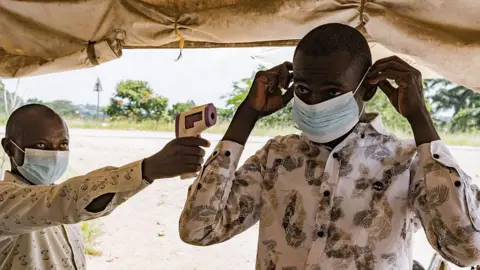
As the outbreak expands into the province of South Kivu and Goma, DR Congo's largest city, the risks increase alongside high levels of insecurity. Several African countries are tightening border screenings and preparing health facilities, with Rwanda closing its borders with DR Congo. On the evacuation front, an American citizen believed to be missionary group doctor Peter Stafford has been removed from DR Congo for treatment of Ebola symptoms, while the US Centers for Disease Control and Prevention (CDC) works to evacuate additional exposed individuals.
Ebola, caused by a virus, initially presents similar symptoms to the flu. This latest outbreak is driven by the Bundibugyo strain of the virus, which is rare and has historically resulted in high mortality rates among those infected. Between 2014 and 2016, the most significant outbreak in West Africa led to over 28,600 infections and around 11,325 deaths.
Officials said more than 513 cases were suspected in DR Congo as of Tuesday, while one person has died in neighboring Uganda. However, modelling by the London-based MRC Centre for Global Infectious Disease Analysis released on Monday suggested there had been substantial under-detection and that it could not rule out the number of cases exceeding 1,000.
WHO chief Tedros Adhanom Ghebreyesus, who declared the outbreak an international emergency last week, expressed deep concern about the scale and speed of the epidemic. Initial fears suggest the outbreak may have been ongoing for several weeks before it was detected on April 24.
There is no existing vaccine for the strain of the Ebola virus currently in circulation, but the WHO is evaluating whether other drugs could provide protection. Dr. Ancia emphasized that the Ituri province, the outbreak's epicenter, is an unsecured area with frequent population movements, complicating the agency's ability to investigate and control the spread of the disease.
As the outbreak expands into the province of South Kivu and Goma, DR Congo's largest city, the risks increase alongside high levels of insecurity. Several African countries are tightening border screenings and preparing health facilities, with Rwanda closing its borders with DR Congo. On the evacuation front, an American citizen believed to be missionary group doctor Peter Stafford has been removed from DR Congo for treatment of Ebola symptoms, while the US Centers for Disease Control and Prevention (CDC) works to evacuate additional exposed individuals.
Ebola, caused by a virus, initially presents similar symptoms to the flu. This latest outbreak is driven by the Bundibugyo strain of the virus, which is rare and has historically resulted in high mortality rates among those infected. Between 2014 and 2016, the most significant outbreak in West Africa led to over 28,600 infections and around 11,325 deaths.