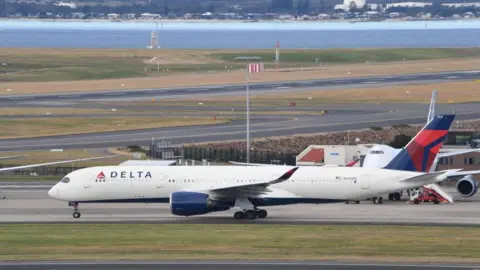
Several people have been injured after a Delta Airlines flight from Los Angeles to Sydney was hit by turbulence on Friday morning.
Delta Flight 41 encountered brief turbulence as it landed at Sydney Airport, an airline spokesperson told the BBC. Four flight attendants were injured, and no passengers were hurt, the airline said.
The New South Wales Ambulance Service said it assessed five patients in total and took three to hospital with minor injuries that included back pain and headaches. The patients' ages ranged from their 30s to 70s.
It is the latest incident of planes being hit by turbulence, with experts saying climate change is a major factor.
There were 245 passengers and 15 crew members on the Airbus A350, the Delta spokesperson said, adding that the plane landed safely and normally at Sydney Airport at 06:48 local time on Friday (19:48 GMT on Thursday).
The NSW Ambulance Service said it received a call just three minutes before the plane landed, and emergency vehicles were waiting on the tarmac.
Last year, 25 people were injured when a Delta Airlines flight, travelling from Salt Lake City to Amsterdam, hit significant turbulence just two hours into the long-haul flight and had to make an emergency landing.
In 2024, passengers and crew on a Singapore Airlines flight experienced severe turbulence; tragically, one passenger died and dozens were injured when those without seatbelts rose out of their seats and fell back down.
Turbulence during flights is relatively common, although strong or severe turbulence cases appear to be rising, they remain infrequent. Estimates suggest there are around 5,000 severe turbulence incidents annually, in over 35 million flights worldwide.
Severe turbulence is classified as conditions that exert more than 1.5g-force on the body, enough to lift unbelted individuals out of their seats.
Experts warn that as climate change continues to shift atmospheric conditions, air travel may become bumpier, with increased frequency and intensity of severe turbulence expected due to changing temperature and wind patterns in the upper atmosphere.