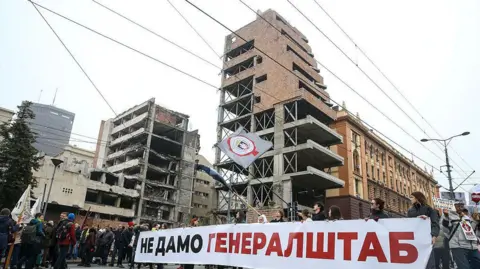
The Trump International Hotel proposed for the Serbian capital Belgrade was supposed to mark a new chapter in the country's modern history. It would take the place of one of the city's most arresting sights: the bomb-damaged, but still semi-functional, remains of the defence ministry complex, or Generalstab (General Staff) as it is otherwise known.
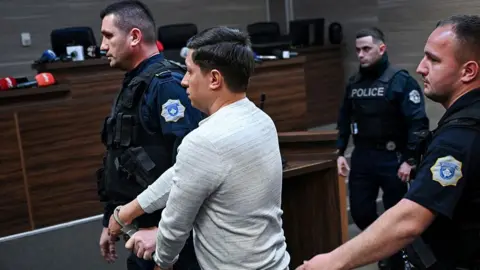
One major obstacle stood in the way: Generalstab was listed as cultural heritage. The government tried to get around this by removing the complex from the register of protected buildings but now Culture Minister Nikola Selakovic is on trial for abuse of office, accused of using his position to influence or falsify documents to revoke Generalstab's cultural heritage status.
Prosecutors are calling for a three-year prison sentence, while President Aleksandar Vucic has promised to pardon the minister if judges convict him. Whatever the verdict, it now seems highly unlikely that anyone will ever be able to check into a Trump International in Belgrade.
The project had always been a hard sell, given the recent history between the US and Serbia. US warplanes carried out the NATO air strikes in 1999 which reduced Generalstab to the shattered state in which it has remained. Bearing in mind that Washington was also the main sponsor of Kosovo's unilateral declaration of independence from Serbia in 2008, there is not an abundance of goodwill towards the US among Serbians.
Surprise turned to outrage with Kushner's announcement last year that a Trump International Hotel would form the centrepiece of the project. Vucic insisted the time was right for Serbia to overcome the burden from 1999. He stated that his governing Progressive Party was ready to build better relations with the US, saying: I think that is terribly important for this country. However, it soon became clear that many Serbs did not share that perspective – at least when it came to Generalstab.
Opposition to Kushner's project brought together an unlikely coalition of architects, military veterans, and student-led anti-corruption protesters. The architects pointed out that the bombed buildings had been the only project completed in Serbia by the renowned Yugoslav architect Nikola Dorbrovic, while the veterans saw them as a de facto memorial for the people who died in the 1999 air strikes.
None of this stopped the government from trying to push through the project. In November, MPs passed special legislation to allow the Trump Hotel to be built. But prosecutors had also been keeping an eye on the affair, particularly efforts to remove Generalstab from the protected heritage register. That led to them bringing charges against the culture minister and three other officials in December. Selakovic responded by calling prosecutors an organised criminal group and an autoimmune disease, accusing them of targeting the president.
The charges proved one controversy too many for Kushner. His company stated they wanted to unite rather than divide and their withdrawal was out of respect for the citizens of Serbia and the City of Belgrade. Vucic has made no secret of his fury over the prosecution of Selakovic and has pushed through amendments to judicial legislation, despite critics' warnings that this would reduce the independence of prosecutors and judges.
As for Kushner, his focus has switched to Albania, where he plans to build a luxury resort on Sazan Island. It is not yet clear whether a Trump International Hotel is in the offing.