In brief
Telegram has filed a suit against a recent government ban on its platform, citing concerns that the move punishes millions of users while failing to curb alleged paper leaks for the National Eligibility‑cum‑Entrance Test (NEET). The ban was enacted just days before a rescheduled retest following a cancellation due to suspected leaks, prompting the National Testing Agency to justify the restriction under India’s IT law. Telegram’s CEO, Pavel Durov, argues the ban is a mistake and that the platform has already removed numerous leak channels, while the government maintains that the block protects the exam’s integrity. The Delhi High Court will hear the case later, amid protests and calls for a more focused approach toward leak perpetrators. The incident highlights the tension between technology regulation and examination security in India.
Telegram has taken the Indian government to court after a temporary ban was imposed on the popular messaging platform ahead of a rescheduled National Eligibility‑cum‑Entrance Test (NEET) exam. The block, instituted under the country’s Information Technology Act, was reportedly triggered by concerns that Telegram channels had disseminated leaked question papers.
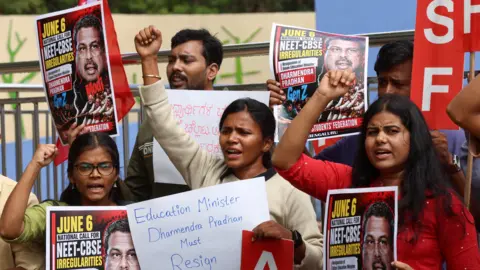
The ban came four days before the retest—a suspension that had already triggered widespread protests across the country as students, activists and opposition leaders rallied against what they described as systemic examination fraud.
Telegram’s chief executive, Pavel Durov, denounced the restriction as a mistake, noting that it would “punish millions of users” and that the platform had removed “hundreds of channels” sharing leaked content. Durov also highlighted efforts to increase the visibility of the platform’s “edited” label to curb seeding of scam content.
The National Testing Agency (NTA), which administers NEET, defended the ban by claiming it was a response to “organised use of the platform by cheating rackets.” However, the agency acknowledged the inconvenience imposed on legitimate users and promised to work with the government to address the issue.
The Delhi High Court has agreed to hear the case later that day, setting the stage for a debate on whether blocking a widely used platform is an effective strategy to tackle examination fraud. Experts note that similar activity could easily migrate to other messaging services such as WhatsApp or Discord, raising questions about the broader implications of platform bans on digital communication and commerce.
Meanwhile, student responses have been mixed: many argue that the focus should be on the leak‑organisers, while a few support the ban as a step toward safeguarding exam integrity. The controversy underscores the complex balance between maintaining academic fairness and protecting digital freedoms in India’s rapidly evolving technology landscape.
Follow BBC News India on Instagram, YouTube, X and Facebook.