With its neat rows of detached family homes, complete with grass lawns and porches, Miraflores could be mistaken for a typical American suburb.
Located in the heartland of Venezuela's oil industry, on the Costa Oriental (Eastern Coast) of Venezuela's Lake Maracaibo, this quiet neighbourhood once helped to make the country one of the wealthiest in Latin America. It was a symbol of national prosperity.
This used to be one of the world's most productive oil basins, and along with the city of Maracaibo, across the lake, is seen as key to President Donald Trump's plan to get US firms to invest $100bn (£75bn) to rebuild Venezuela's energy industry. The country has the world's largest proven oil reserves, estimated at about 303 billion barrels.
But for now, the area around Lake Maracaibo stands as a stark reminder of how much the country's fortunes have declined over the decades.
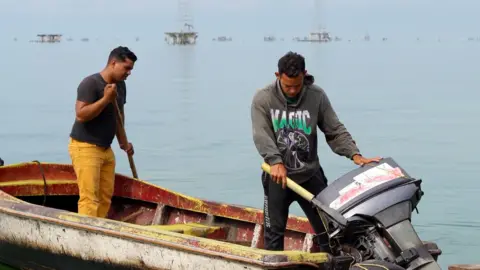
There are oil pumps and rigs dotted everywhere - on street corners, in surrounding fields and rising out of the lake. While a handful have been freshly painted in the yellow, blue and red of the national flag and remain operational, many others have not moved in years and are rusting and falling apart.
The decay is striking in the 20 or so American-style oil camps on the fringes of the lake - these were originally built by international companies to house their workforce, after the commercial exploitation of Venezuela's oil reserves took off in the 1920s.
Oil giants such as Standard Oil of New Jersey (which later became Exxon), Chevron and Shell invested heavily in Maracaibo, Venezuela's second-largest city. Oil money turned former fishing villages into affluent communities with hospitals, schools, and social clubs.
In Miraflores, which housed the industry's top executives, many homes now sit abandoned and looted, their windows smashed and wiring stripped bare.
Gladysmila Gil moved to a more modest neighbourhood nearby in 1968 with her late husband, who worked in the oil industry and had the home given to him.
When we moved into this house, it was in good condition, she recalls, sitting on a frayed chair and looking at the pink paint peeling off the walls.
If we were sick, we went to the hospital and they treated us. The rubbish was collected every other day, and we didn't have these power outages, she adds of the economic decline Venezuela has experienced over the past 13 years.
Now rubbish is only collected sporadically and despite the oil reserves, the region has been hit by a severe energy crisis over the past decade with blackouts reported almost daily.
Many cite 2002 as a turning point for the industry, when a strike by oil workers against Chávez's government was followed by a sweeping overhaul of PDVSA. It is widely reported that up to 22,000 people were fired.
In 2007, the oil sector was transformed again when President Chávez's government seized control of the industry.
Yet for many in Maracaibo, hope remains that investment and prosperity will return.
Among them is 93-year-old José Rodas, a retired oil worker who still owns a special-edition Dodge Dart, a classic American muscle car that he bought during the 1970s oil boom.
Things have become more difficult, he says. In the past, life was easier. We had comforts then.