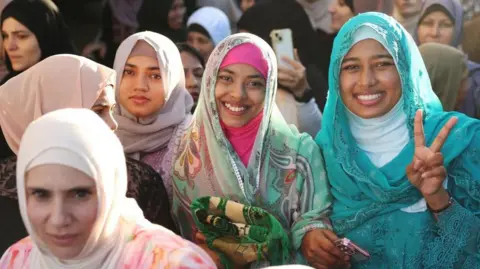
As sunset approached in the south-western Sydney suburb of Lakemba last week, the street outside the Imam Ali bin Abi Taleb Mosque was filled with thousands of people, most of whom found a seat at one of many trestle tables covered with white table cloths. The mosque was hosting a community Iftar: the evening meal that marks the end of daily fasting in Ramadan.
The tables were divided into sections, marked by buffet stations labelled 'women' and 'men', and as the sun went down families brought out boxes of dates to break their fast, offering them around to neighbours and other guests. Yet despite the family-friendly vibe of this event, a police surveillance trailer parked in the road - complete with 360 cameras on tall poles - spoke to fears within the community.
Reported incidents of Islamophobia have increased 636% since violence erupted in Israel and Gaza in October, prompting many in the local Muslim community to feel unsafe. Gamel Kheir, secretary of the Lebanese Muslim Association, organized the community Iftar and acknowledged the challenging environment. If ever there was a need for communities to come together and break bread, I would say this year is more important than ever, he said.
Statistics reveal that an average of 18 Islamophobic incidents occur weekly in Australia, escalating fears among community members during holy celebrations. Although many came together to celebrate their faith, the sentiment persisted that marginalized voices, particularly in the Muslim community, face significant threats to their safety and representation.
As the community leaders echo their concerns, they call upon greater political engagement and inclusivity, emphasizing that discriminatory acts should not tarnish the diverse tapestry of Australian society.
The tables were divided into sections, marked by buffet stations labelled 'women' and 'men', and as the sun went down families brought out boxes of dates to break their fast, offering them around to neighbours and other guests. Yet despite the family-friendly vibe of this event, a police surveillance trailer parked in the road - complete with 360 cameras on tall poles - spoke to fears within the community.
Reported incidents of Islamophobia have increased 636% since violence erupted in Israel and Gaza in October, prompting many in the local Muslim community to feel unsafe. Gamel Kheir, secretary of the Lebanese Muslim Association, organized the community Iftar and acknowledged the challenging environment. If ever there was a need for communities to come together and break bread, I would say this year is more important than ever, he said.
Statistics reveal that an average of 18 Islamophobic incidents occur weekly in Australia, escalating fears among community members during holy celebrations. Although many came together to celebrate their faith, the sentiment persisted that marginalized voices, particularly in the Muslim community, face significant threats to their safety and representation.
As the community leaders echo their concerns, they call upon greater political engagement and inclusivity, emphasizing that discriminatory acts should not tarnish the diverse tapestry of Australian society.