In brief
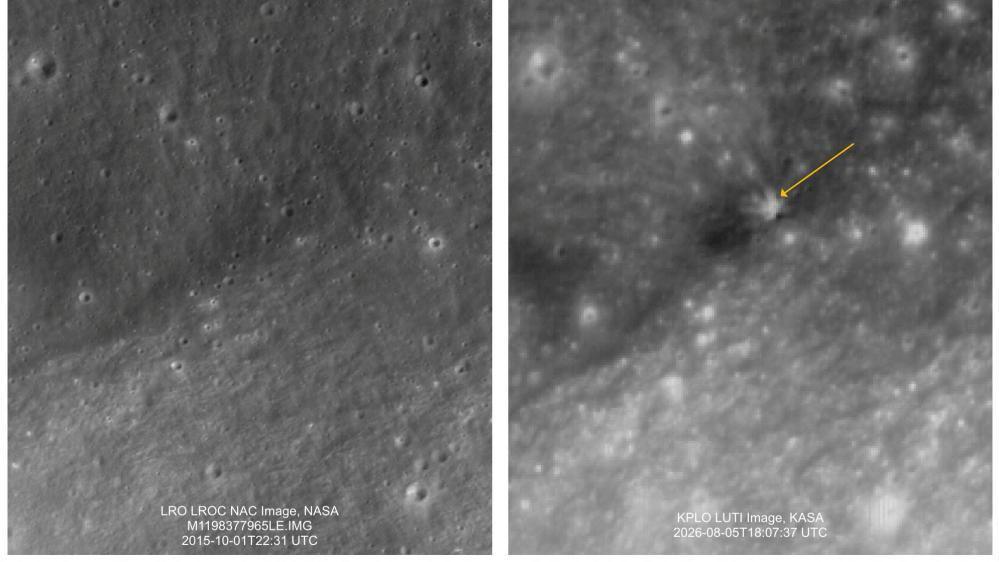
A SpaceX Falcon 9 upper stage crashed onto the Moon on 6 August 2026, prompting South Korea’s KASA to release imagery that captures the impact site. The fragment, a 5‑storey‑high, 4000kg rocket component, had been drifting in a looping orbit since January 2025 after launching a lunar lander. The KASA orbiter Danubri captured high‑resolution images that reveal a faint flash and crater formation. Scientists are analysing the event to understand how such debris can affect future missions and to evaluate the increasing congestion of space objects. As SpaceX prepares its 18th launch of the same booster on 10 August, experts warn that the growing volume of discarded parts could make it harder to navigate Earth’s orbit.
A SpaceX Falcon 9 upper stage crashed onto the Moon on 6 August 2026, prompting South Korea’s KASA to release imagery that captures the impact site.
The fragment, a 5‑storey‑high, 4000kg rocket component, had been drifting in a looping orbit since January 2025 after launching a lunar lander. The satellite Danubri collected high‑resolution images showing a faint flash and a new crater.
The upper stage was propelled to a speed of about 5,400mph (8,700km/h) when it entered the Moon’s path. It is the same booster that will return to Earth after completing its previous missions.
Scientists analyse how Earth, Moon and Sun gravity nudged the piece, incrementally increasing its velocity until the impact occurred during daylight for many parts of the world, yet the flash was too faint to be seen even with large telescopes.
Space debris is a growing concern; astronomers warn that future missions may find it increasingly difficult to maneuver around Earth’s orbit as more objects populate space.
SpaceX plans to launch the same booster for its 18th flight on 10 August, intending to send 29 Starlink satellites into low‑Earth orbit. The launch will begin a new cycle of reuse and further fueling the debate over sustainable space practices.