In brief
As companies race to create humanoid robots, the technological and logistical challenges remain significant. Leading players like Unitree and Tesla are positioned against a backdrop of Asia's dominance in robotics, but questions on automation compatible with daily life linger.
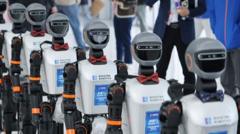
It’s a bright spring morning in Hanover, Germany, where the buzz of anticipation surrounds the G1, a humanoid robot from Chinese company Unitree, showcased at the Hannover Messe - one of the largest industrial trade shows globally. Standing at merely 4'3" (130 cm), this robot is both affordable and agile, showcased through viral videos of it dancing and performing martial arts. Controlled remotely by Unitree’s sales manager, Pedro Zheng, the G1 engages attendees, with many approaching it to shake its hand or interact in other ways, demonstrating its uncanny human-like form that induces comfort.Yet, while companies worldwide are eager to innovate humanoid robotics, the technology still needs refinement. Although robotic arms and mobile robots are already widespread in controlled environments like factories, venturing humanoid robots into unpredictable settings, such as homes or restaurants, introduces complexity. Making humanoid robots not just functional but safe poses additional challenges, prompting concerns over their strength and stability. "The AI simply has not yet reached a breakthrough moment," a Unitree spokesperson shared, highlighting the limitations in current robotics.Currently, the G1 is geared toward research institutions and tech companies, flush with open-source software for autonomous development. In competitive landscapes, firms like Tesla, under Elon Musk, are also delving into humanoid robotics with their Optimus project, which aims to introduce thousands of these robots within their factories soon. Other car manufacturers are joining the fray, exemplified by BMW's introduction of humanoid robots in U.S. operations and Hyundai's substantial orders from Boston Dynamics, acquired in 2021.According to Thomas Andersson of research firm STIQ, roughly 49 firms are currently creating humanoid robots, while relaxing the definition expands that number to over 100. He projects Chinese companies will dominate the landscape, benefiting from a robust supply chain and government support for technological advancements. Starting at $16,000, the G1 from Unitree exemplifies the affordability coupled with strong incentives for innovation in the region.However, U.S. and European contenders encounter challenges when competing against this technological juggernaut. Bren Pierce, founder of Kinisi in the UK, notes that complex assembly from parts sourced globally can be counterintuitive, leading to manufacturers opting for simpler forms devoid of legs. The KR1 robot he's launched thrives in environments such as warehouses without needing the complexity of a fully humanoid design.Pierce emphasizes that the true value lies in the robot's software, constructing user-friendly interfaces that grant operations managers easy control of robotic functions within hours of training. The KR1 is designed to learn tasks through human guidance and could redefine workplace efficiency.Ultimately, although a dream exists of humanoid robots seamlessly integrating into homes, such advancements are anticipated to be at least a decade or more away. The pursuit of creating a versatile "everything robot" remains a complicated quest, indicating that while the technology inches forward, we are still in the early stages of a revolutionary journey in robotics.