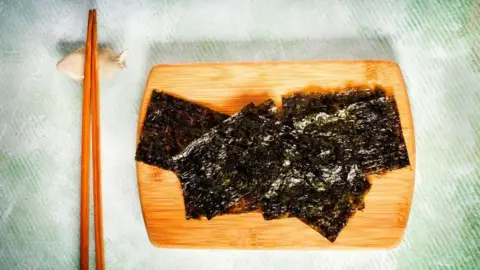
Black, crispy, often flat and square - dried seaweed, known locally as gim - is a humble staple on everyday dining tables across South Korea. But as its global popularity grows, its rising prices are worrying gim-lovers nationwide.
Lee Hyang-ran has been selling gim for the past 47 years. In the past, people from Western countries thought Koreans were eating something weird that looks like a piece of black paper, the vendor, who is in her 60s, says from a small market stall in central Seoul. I never thought I'd be selling gim to them. But now, they all come here and buy it.
South Korea is known to be the world's largest producer and exporter of gim, supplying markets across Asia, North America, and Europe. Exports have risen steadily in recent years - and in 2025, South Korea's dried seaweed exports hit a record $1.13bn, according to the Korea Maritime Institute (KMI). And as demand rises, so do prices.
Known locally as an affordable snack or ingredient, gim typically cost around 100 won ($0.06; £0.05) per sheet in 2024 - with the snack usually sold in bundles of 10 sheets or more, or around $0.60 per pack. But last month, the price of one sheet of gim rose to above 150 won - a record high in the country. Premium products now cost as much as 350 won per sheet, said Lee.
The worldwide appetite for gim reflects a growing global demand in Korean goods, driven by cultural influences like K-pop and K-dramas. As global audiences engage more deeply with entertainment, they're increasingly exploring Korean cuisine, something businesses worldwide have capitalized on. In 2023, US supermarket chain Trader Joe's Gimbap - a Korean rice roll wrapped in seaweed - went viral and was cleared off the shelves shortly after its launch.
Kim Namin, 29, runs a seasoned gim processing factory on Wando, an island in South Korea's southern waters. His factory purchases raw seaweed, grills it with oil and salt, and cuts it into rectangular sheets. Over the past five years, most of their products have been exported globally. There aren't enough gim factories compared to the rising demand, he said, adding that his family is considering expanding operations.
Meanwhile, government officials and experts attribute the price increase to inflation, rising labor costs, and declining global production. However, many agree that increased global demand remains a major driver. In response, the Ministry of Oceans and Fisheries in South Korea has pledged to monitor the situation to stabilize prices and encourage local production methods.
Lee Hyang-ran has been selling gim for the past 47 years. In the past, people from Western countries thought Koreans were eating something weird that looks like a piece of black paper, the vendor, who is in her 60s, says from a small market stall in central Seoul. I never thought I'd be selling gim to them. But now, they all come here and buy it.
South Korea is known to be the world's largest producer and exporter of gim, supplying markets across Asia, North America, and Europe. Exports have risen steadily in recent years - and in 2025, South Korea's dried seaweed exports hit a record $1.13bn, according to the Korea Maritime Institute (KMI). And as demand rises, so do prices.
Known locally as an affordable snack or ingredient, gim typically cost around 100 won ($0.06; £0.05) per sheet in 2024 - with the snack usually sold in bundles of 10 sheets or more, or around $0.60 per pack. But last month, the price of one sheet of gim rose to above 150 won - a record high in the country. Premium products now cost as much as 350 won per sheet, said Lee.
The worldwide appetite for gim reflects a growing global demand in Korean goods, driven by cultural influences like K-pop and K-dramas. As global audiences engage more deeply with entertainment, they're increasingly exploring Korean cuisine, something businesses worldwide have capitalized on. In 2023, US supermarket chain Trader Joe's Gimbap - a Korean rice roll wrapped in seaweed - went viral and was cleared off the shelves shortly after its launch.
Kim Namin, 29, runs a seasoned gim processing factory on Wando, an island in South Korea's southern waters. His factory purchases raw seaweed, grills it with oil and salt, and cuts it into rectangular sheets. Over the past five years, most of their products have been exported globally. There aren't enough gim factories compared to the rising demand, he said, adding that his family is considering expanding operations.
Meanwhile, government officials and experts attribute the price increase to inflation, rising labor costs, and declining global production. However, many agree that increased global demand remains a major driver. In response, the Ministry of Oceans and Fisheries in South Korea has pledged to monitor the situation to stabilize prices and encourage local production methods.