In brief
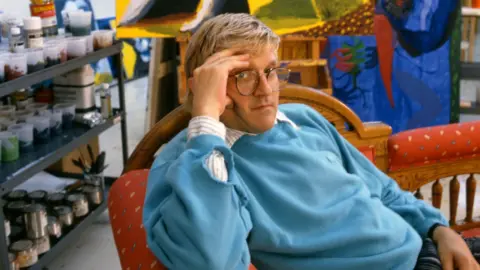
David Hockney, born in 1937, grew up in Bradford before moving to London’s Royal College of Art, where he developed a relentless work ethic and a bold, colourful style. His 1960s ‘swimming‑pool’ paintings, featuring suspended tank glamour, captured a new Californian and queer aesthetic, propelling him to international fame and commercial success—his 2017 sale of "A Bigger Splash" is a record for a living artist. Hockney’s pioneering use of technology—from Polaroid collages to iPad portraits—remained a hallmark of his practice, bridging past and future in art. He remained outspoken on politics, championed LGBTQ+ rights, and engaged in activism during the AIDS crisis. He continued to innovate well into his 80s, producing large-scale landscapes in Normandy and immersive 4D installations. Hockney’s legacy rests on his fearless experimentation, social commentary, and enduring influence across generations of artists.
David Hockney was born on 9 July 1937 in the harsh environment of Bradford, England, where he grew up with a family that resisted social injustice and held a strong work ethic. After refusing his teachers’ advice and continuing with art through the Royal College of Art in London, Hockney developed a fierce discipline—making 12 hours of work daily, an ethic that set his career in motion.
The 1960s marked Hockney’s emergence as a visionary, fueled by the swirling pop and abstract expressionist currents. He conquered the Californian dreamscape that embodied cultural freedom and sexual liberation. His signature swimming‑pool paintings—most famously "A Bigger Splash"—employed bright acrylics, rigorous composition, and a sense of physical immediacy, making them universally recognizable.
His work transcended canvas. In the 1970s, Hockney’s fascination with Polaroid collages expanded into massive photocopied and faxed pieces. He later embraced the digital age, mastering iPad painting and digital photography to create intimate portraits of allies (including the British royalty and pop star Harry Styles) and landscapes of Normandy made during lockdown. In each medium, Hockney remained faithful to his motto: paint whatever you love.
Beyond his aesthetically bold offerings, Hockney was socially and politically outspoken. He championed LGBTQ rights during the AIDS crisis, revoked his acceptance of a knighthood, and critiqued governmental stances on art freedom. His activism, coupled with his generative use of emerging art technology, kept him at the forefront of the art world well into his eighties.
Hockney’s legacy is a testament to relentless vision, innovative application of new media, and an indomitable spirit that anchored him as a pillar of modern British art. He will be remembered for the joy of the splash, the light of a Californian pool, and a steadfast commitment to creative exploration that spanned decades.